
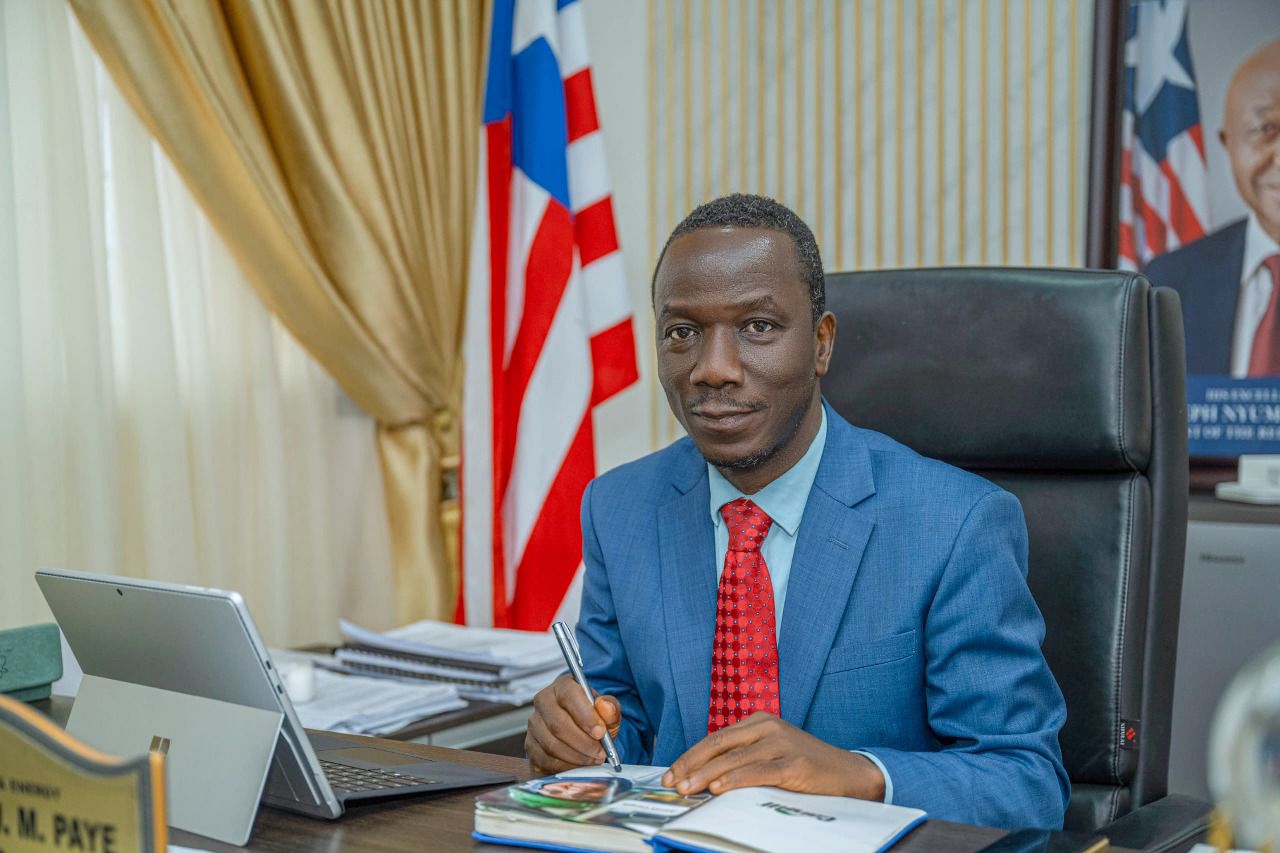
At the 21st Association of Power Utilities of Africa (APUA) Congress held in Egypt, Liberia’s Minister of Mines and Energy, Wilmot Paye, stepped onto the global stage with a narrative that balanced the gravity of Liberia’s current energy crisis against the soaring rhetoric of the government’s new policy frameworks. As he addressed delegates, Paye painted a stark picture of a nation held hostage by its own power grid, a system defined by extreme fragility, exorbitant costs, and a haunting, persistent darkness that stifles economic development for the vast majority of Liberians. Yet, amidst this grim landscape, Paye championed the ‘ARREST’ Agenda and a newly minted Five-Pillar National Energy Compact as the vehicles for a radical transformation. For a country that has struggled for decades to provide consistent electricity, these targets represent the most audacious planning in recent memory.
However, for seasoned analysts and the long-suffering Liberian public, the question remains whether these commitments are a genuine blueprint for revitalization or merely aspirational declarations disconnected from the structural, financial, and logistical realities on the ground. The current state of Liberia’s energy sector is nothing short of a crisis. Liberia remains one of the most under-electrified nations in the world, with only about 30% of the population—mostly confined to urban centers like Monrovia—having access to a grid that is itself remarkably unreliable. The reliance on the Mount Coffee Hydropower Plant, with its 88MW capacity, provides a glimpse of potential, yet this asset is effectively hamstrung by seasonal variability.
When the dry season hits and water levels recede, the nation’s capacity to generate cheap, clean power evaporates. To compensate, the Liberia Electricity Corporation (LEC) relies on thermal power plants with 38MW of capacity. This energy comes at a staggering price point of $0.33 per kilowatt-hour, a figure that is more than double the regional average in West Africa.
This creates an economic paradox: industries that are already struggling to survive must pay a premium for a utility that is constantly subject to load shedding, brownouts, and localized failures. Even the ambitious CLSG (Côte d'Ivoire, Liberia, Sierra Leone, and Guinea) regional transmission line, which was heralded as a panacea for the region’s power shortages, remains underutilized in the Liberian context. While the physical infrastructure exists, the internal distribution networks in Liberia are aging, porous, and plagued by illegal connections and technical losses. When electricity is imported, it often struggles to traverse the final mile to the consumer because of these chronic infrastructure bottlenecks.
Minister Paye’s articulation of the ARREST Agenda and the Five-Pillar National Energy Compact is his way of addressing these systemic failures. The pillars—which focus on strengthening infrastructure, deepening regional integration, scaling up renewable energy sources, inviting private sector participation, and aggressively reforming the finances of the LEC—form a comprehensive strategy. The government’s goal of reaching 75% electricity access by 2030 is undeniably bold. It requires a Herculean effort that would challenge even the most robust economies, let alone one that is still grappling with the lingering consequences of a civil war that dismantled its entire utility landscape in the 1990s.
To understand the significance of Paye’s presentation, one must look at the historical context of the Liberian energy sector. For years, the sector was defined by a total collapse of public infrastructure, leading to a decade where electricity was the exclusive domain of those who could afford private diesel generators. This 'generator economy' became deeply entrenched, creating a class of influential stakeholders who arguably benefit from the current dysfunction. Reforming this system is not just a technical challenge; it is a political one.
When the LEC struggles to recover costs, it is not merely because of technical incompetence, but because of a legacy of uncollected bills, systemic theft, and a lack of political will to enforce payment among the political elite and large public institutions. Paye’s mention of installing prepaid meters for public institutions is a critical, albeit politically sensitive, step toward addressing these 'fiscal leaks.' By forcing government ministries and agencies to pay for their consumption, the LEC can begin to stabilize its balance sheet, creating the predictability needed to attract independent power producers (IPPs). Furthermore, the government’s move to place oversight of energy projects under the purview of the Vice President’s office reflects an attempt to elevate the sector’s priority status, signaling to international donors and private investors that the administration is prepared to cut through bureaucratic red tape.
However, skepticism remains pervasive within the international development community. Critics point out that past energy initiatives have often been marred by poor project management and a lack of continuity across different political administrations. The timeline to reach 75% by 2030 is incredibly tight. Achieving this would require not just massive capital investment—which the Liberian government does not currently possess in its national budget—but also a total overhaul of the regulatory environment to ensure that private investors feel their capital is secure.
The proposed Net Metering Policy, which seeks to allow solar producers to feed energy back into the national grid, is a progressive step that could decentralize power generation. By incentivizing homeowners and businesses to install their own solar arrays and contribute to the collective supply, Liberia could reduce its reliance on the centralized, expensive thermal plants. Nevertheless, the technical capacity of the current grid to handle variable input from solar remains a significant concern. Without substantial investments in smart-grid technology and grid modernization, the integration of renewables could prove to be more disruptive than helpful.
At the APUA Congress, Paye’s tone was a departure from the usual defensive posture often adopted by Liberian officials. He acknowledged the 'entrenched darkness' that many citizens face daily, an admission that served as an implicit indictment of both previous administrations and the structural inertia that characterizes the current sector. By framing the goal as 'achievable' while conceding the existence of 'seasonal volatility' and 'debt burdens,' Paye attempted to bridge the gap between the dream of energy security and the nightmare of the current status quo. The road ahead for the Ministry of Mines and Energy is fraught with peril.
Success will not be determined by the elegance of the Five-Pillar Compact, but by the relentless enforcement of financial discipline and the speed with which the government can modernize the transmission and distribution networks. Regional integration through the CLSG line remains the most viable pathway to immediate, reliable power, but this requires Liberia to be a reliable partner in a regional network, paying its dues and maintaining its local substations to global standards. As Minister Paye navigates the complexities of the energy landscape, he must contend with the reality that for the average Liberian entrepreneur or family, the ARREST Agenda is just another policy document until the lights stay on for more than twenty-four consecutive hours. The journey to 2030 is long, but the decisions made in the next eighteen months—regarding tariff structures, private investment protections, and the rehabilitation of existing hardware—will determine whether the Ministry’s audacity will be rewarded with progress or remembered as another missed opportunity in a long history of institutional underperformance.
