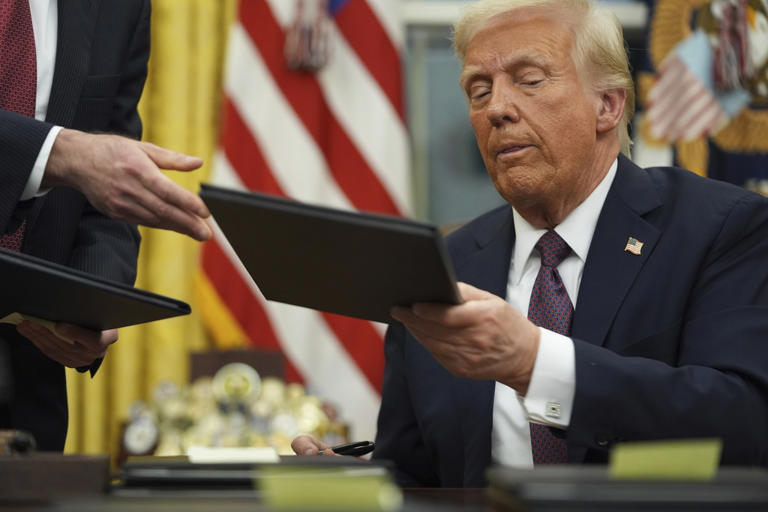
The return of Donald Trump to the White House and his immediate issuance of an executive order suspending U.S. foreign assistance for a 90-day period has sent shockwaves through the corridors of power in Monrovia. For a nation like Liberia, which has historically functioned as a primary beneficiary of American goodwill, diplomatic patronage, and development largesse, this directive is far more than a routine administrative pause.
It represents a potential seismic shift in the geopolitical architecture that has defined Liberia-U.S. relations since the founding of the Liberian state. As the Trump administration prioritizes its ‘America First’ mandate, the structural vulnerabilities of aid-dependent economies in West Africa are being laid bare, forcing a reckoning that Liberian policymakers can no longer afford to delay.
This 90-day hiatus is not merely a bureaucratic bottleneck; it is a precursor to a potential fundamental realignment of American foreign policy that could strip away the safety nets upon which the Liberian healthcare, education, and security sectors heavily rely. The historical bond between Liberia and the United States, rooted in the 19th-century settlement of freed American slaves, has evolved into a modern-day partnership defined by USAID-funded interventions. From the post-civil war reconstruction efforts to the frantic, donor-led response during the 2014 Ebola crisis, American aid has been the bedrock of Liberia’s fragile stability. Currently, programs like the President’s Emergency Plan for AIDS Relief (PEPFAR) and various USAID-led agricultural and governance initiatives serve as the lifeblood for thousands of Liberians.
A sudden cessation of these programs would not only halt progress but could trigger a regression in health outcomes and economic growth that would take years to remediate. During this 90-day review period, the uncertainty surrounding the future of these disbursements creates a ‘policy paralysis.’ Ministries in Liberia that depend on the predictability of donor-funded budgetary support now face the grim prospect of stalled procurement, halted infrastructure projects, and the suspension of critical social services. The financial architecture of the Liberian state is fundamentally tied to the continuity of these external inflows.
Without the buffering effect of international support, the domestic budget—already constrained by low tax buoyancy and high debt servicing obligations—would struggle to fill the void. The fiscal implications are stark: should the administration choose to permanently cut or pivot aid away from traditional development sectors toward strictly transactional, security-focused, or ideological objectives, Liberia could face a catastrophic service delivery gap. The implications of this policy shift extend far beyond the borders of Liberia, potentially destabilizing the broader Mano River Union region. West Africa is currently grappling with a resurgence of military coups, democratic backsliding, and the pervasive threat of transnational violent extremism.
The United States has long utilized foreign aid as a ‘soft power’ instrument to anchor democratic norms and institutional stability in the region. If the Trump administration’s re-evaluation results in a widespread retreat from development funding, the resultant power vacuum will inevitably be filled by other global actors. China, with its non-conditional investment models, and Russia, through its increasing focus on security partnerships, are poised to pivot into the space left by a retreating America. While some might argue that diversification of partners is a strategic necessity for Liberia, the sudden loss of U.
S. institutional support would be a massive shock to the system. The diplomatic landscape has shifted; whereas previous U.S.
administrations emphasized the ‘Washington Consensus’ and liberal democratic values, the current climate favors a cold, transactional approach where every dollar of aid must be justified through the lens of specific U.S. domestic interests. For the Liberian government, this reality necessitates an urgent paradigm shift.
The reliance on foreign aid as an economic strategy is an unsustainable relic of the post-conflict era. The government must now move aggressively toward mobilizing domestic revenue, closing tax loopholes, and incentivizing local private sector growth to create a buffer against the whims of foreign donor politics. This requires a difficult, politically sensitive transition away from the patronage-heavy budget structures that have characterized Liberian governance for decades. Furthermore, the Liberian administration must become more adept at ‘aid diplomacy.
’ It is no longer sufficient to be a passive recipient of American largesse. The current geopolitical environment demands that Liberia clearly articulate how its stability, democratic adherence, and governance metrics align with the broader strategic and economic interests of the United States. Whether through enhanced regional trade cooperation, anti-corruption reforms that satisfy international accountability standards, or strategic security partnerships that address migration and regional stability, Liberia must position itself as an indispensable partner rather than a perpetual beneficiary. The long-term impact on U.
S. soft power is another critical dimension of this crisis. By conditioning or slashing aid, the United States risks eroding decades of investment in human capital and institutional development across Africa. If the U.
S. retreats, the message sent to the global South is that democratic partnership is conditional, ephemeral, and subject to the changing whims of the American electoral cycle. This perceived unreliability could undermine U.S.
strategic objectives in the long run, as countries seek more predictable, albeit different, alliances. Ultimately, the Trump administration's executive order acts as an alarm bell. It forces Liberia to confront the uncomfortable reality that its national development strategy cannot forever be anchored in the benevolence of external powers. While the 90-day period will be a testing ground for Liberian diplomatic resilience, the coming months will also serve as a final warning that the status quo of high-dependency, aid-reliant governance is nearing its expiration date.
For the Liberian people, the stakes could not be higher. The path forward requires a synthesis of domestic reform, strategic regional positioning, and the painful yet necessary realization that true sovereignty is built upon economic self-reliance. As Insights Liberia continues to track the developments within this 90-day review period, we urge both the Liberian legislature and the executive branch to use this time not to wait for the storm to pass, but to build the institutional floodwalls required to protect the nation’s future.