
The Republic of Liberia is currently navigating a period of profound geopolitical and economic uncertainty, underscored by a high-stakes confrontation between established industrial powerhouses and the aspirations of a new administration. At the heart of this storm is the Yekepa-Buchanan rail and port corridor—the lifeblood of the nation’s mining sector. Over the weekend, the Government of Liberia, led by President Joseph Nyuma Boakai, entered into a reportedly closed-door rail access agreement with Ivanhoe Atlantic, formerly known as HPX. The event, shrouded in secrecy with the media barred and critical details withheld, has ignited a firestorm of speculation regarding the sanctity of national contracts, the influence of foreign actors, and the potential for debilitating international litigation.
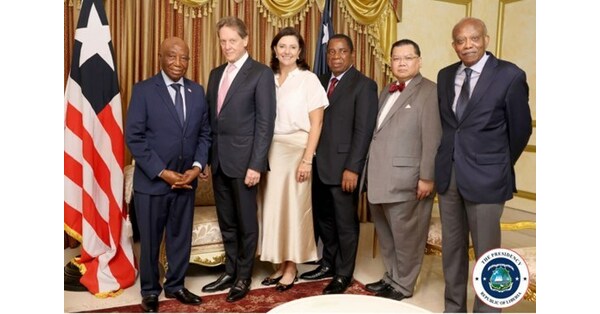
L-R, the President of Liberia, Joseph Nyuma Boakai, Mr. Robert Friedland, Ms. Bronwyn Barnes, Mr. Robert Gumede, Amb.
(ret) Peter Pham and Gerald Padmore appeared in imagery surrounding the event, signaling the heavy-hitting nature of the players involved. Yet, for a nation still grappling with the scars of historical economic mismanagement and a fragile reputation for investment integrity, this lack of transparency is a troubling indicator of how Liberia chooses to engage with its international partners. The Liberian Observer, often viewed as the primary mouthpiece for HPX’s local messaging, broke the news of the signing, yet the broader press corps was relegated to the periphery. By denying the public and the independent media access to the details of this agreement, the government has inadvertently signaled that the terms of the deal may be too contentious or legally precarious to survive the heat of public scrutiny.
This approach contrasts sharply with the demands of the modern, transparent governance Liberia claims to champion. The core of this dilemma rests upon the 2007 Mineral Development Agreement (MDA) signed with ArcelorMittal Liberia (AML). To understand the severity of the current situation, one must look back at the origins of the MDA. Signed in the post-civil war era when Liberia was desperate to attract foreign direct investment, the MDA was designed to incentivize massive capital expenditure by granting ArcelorMittal exclusive operational rights over the railway and port infrastructure until 2030.
This document is not merely a contract; it is a legally ratified instrument that has defined the rules of engagement for nearly two decades. In the world of international law, an MDA functions as the bedrock of stability for investors. It outlines performance milestones, environmental responsibilities, and, crucially, robust dispute resolution mechanisms. These provisions, typically under the jurisdiction of the International Centre for Settlement of Investment Disputes (ICSID) or the International Chamber of Commerce (ICC), are intended to protect both the investor and the state from arbitrary political shifts.
By moving to open the rails to Ivanhoe Atlantic before the expiration of AML’s exclusivity, the Liberian government is testing the elasticity of these legal obligations. This is a high-risk maneuver. History across the African continent and in developing economies worldwide is replete with examples of governments that, in attempting to circumvent long-term concession agreements for immediate political or economic gain, have found themselves embroiled in costly arbitration cases that result in massive financial penalties, capital flight, and the chilling of new investment. The timing of this clandestine signing is far from incidental.
President Joseph Boakai is currently preparing for a landmark White House summit with U.S. President Donald Trump, where discussions regarding critical minerals and strategic commercial partnerships are expected to dominate the agenda. The HPX deal is being widely interpreted as a tactical move by the Boakai administration to align Liberia with U.
S. foreign policy objectives. As global superpowers compete for control over the critical mineral supply chains necessary for the transition to green energy and advanced electronics, West Africa’s iron ore deposits have become a geopolitical battlefield. The United States has made no secret of its desire to see Western-backed firms, such as those associated with Robert Friedland’s Ivanhoe, displace or challenge the dominance of existing entities like ArcelorMittal.
For Liberia, the allure of American strategic favor is immense. Historically, the nation has often pivoted its economic policy to mirror the preferences of its most significant international partners. However, history also serves as a warning: chasing foreign approval at the expense of established domestic legal frameworks often leaves a country vulnerable. If the sanctity of a contract can be disregarded to appease a powerful diplomatic partner today, what assurance does the international community have that the same will not happen to them tomorrow?
The implications for Liberia’s investment climate are significant. Investors do not operate in a vacuum; they watch closely how host governments treat existing partners. A reputation for unpredictability—or a tendency to use legal shortcuts to fulfill political mandates—can permanently raise the country’s cost of capital. When investors perceive that political risk outweighs the potential for profit, they demand higher returns, which in turn discourages the very sustainable infrastructure development that Liberia so desperately needs.
Furthermore, the role of Ivanhoe Atlantic (HPX) itself warrants scrutiny. The firm brings a reputation for extensive mining expertise and a vision for multi-user, open-access infrastructure. Proponents argue that the current rail regime, held solely by AML, suppresses the broader development of the Nimba-Grand Bassa corridor, effectively acting as a bottleneck to the country’s economic potential. If managed through a transparent, multilateral framework, an open-access model could indeed unlock value for smaller mining concessions, stimulate local enterprise, and foster a more competitive industrial landscape.
However, the path taken to achieve this vision matters. By sidelining transparency and appearing to act in defiance of a binding MDA, the government risks framing this transition not as a legitimate move toward a modern, competitive economy, but as an act of corporate and political bullying. The tension between the government’s desire for progress and its duty to respect the rule of law is palpable. Lawmakers have already begun to signal concern, with some calling for a public hearing to demand financial and concession reports, reflecting a growing anxiety among the political class that the executive branch may be exceeding its constitutional reach.
The fact that the Economic Advisor to the President has had to fend off accusations of disrespectful conduct by foreign actors regarding the rail dispute suggests that the friction is not just external, but deeply integrated into the current administration’s decision-making process. As Liberia stands at this critical juncture, the question is whether it can navigate the complex web of legacy agreements and new geopolitical realities. If the HPX-AML dilemma is resolved through further legal wrangling, the country faces years of uncertainty and potential fiscal ruin. If, however, the government can find a way to reconcile the expansion of rail access with its existing legal commitments, it may yet prove that Liberia is ready to participate in the global economy as a fair, predictable, and transparent partner.
The coming months will be the true test. The international community, observers, and the people of Liberia will be watching closely to see if this is truly an era of breaking free from coercion or if Liberia is simply threading on even more dangerous ground.


