
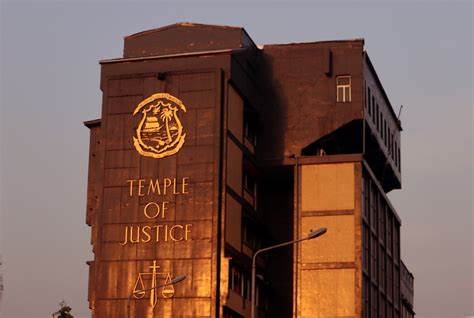
The Weight of Justice: Liberia’s Supreme Court Faces a Democracy-Defining Moment. The ongoing constitutional crisis involving the removal of House Speaker J. Fonati Koffa serves as a sobering mirror to Liberia’s fragile democratic experiment. As the case moves through the chambers of the Supreme Court, the institution finds itself at a defining inflection point.
Fraught with persistent allegations of executive encroachment, systemic bribery, and procedural delays, the judiciary is under intense scrutiny. The nation watches with bated breath, acutely aware that Liberia’s democracy—already frayed by legislative dysfunction and persistent executive overreach—risks further erosion if the bench fails to assert its independence as the ultimate constitutional arbiter. Historically, the Liberian judiciary has mirrored the volatility of the nation’s political landscape. Under the William R.
Tolbert Jr. administration, the Supreme Court adopted a posture of tactical caution, effectively avoiding confrontation with the Executive Branch. While this approach provided a veneer of stability, the Court’s failure to challenge structural inequities left it profoundly ill-equipped to mediate the brewing socio-political storms that would soon consume the country. This pattern of deference reached a nadir during the Samuel K.
Doe era. The judiciary’s validation of the deeply flawed 1985 presidential elections remains a cautionary tale of how the erosion of judicial integrity can facilitate systemic state collapse. By legitimizing a fraudulent process, the Court signaled that political survival outweighed constitutional fidelity, directly contributing to the descent into civil war. Similarly, the Charles Taylor years witnessed the near-total subordination of the judiciary.
Under an authoritarian regime, the courts were repurposed as instruments for power consolidation, stripping them of their role as independent guardians of the law. When peace finally returned in 2003, the Liberian judiciary was not merely ineffective; it was a shell of its intended self, requiring comprehensive reconstruction. The post-war landscape, beginning with the administration of Ellen Johnson Sirleaf, offered a brief window for optimism. While the Sirleaf-era Court demonstrated flashes of independence—particularly regarding land disputes and specific electoral challenges—the credibility of the institution was consistently undermined by pervasive corruption and patronage.
The controversies surrounding the 2011 re-election cycle and the appointment of Chief Justice Francis S. Korkpor, which critics decried as an executive overreach into judicial affairs, highlighted that the old ghosts of political influence had not been fully exorcised. This legacy of institutional vulnerability culminated during the tenure of President George Manneh Weah (2018-2024). The impeachment of Justice Kabineh Ja'neh, the unexplained disappearance of newly minted Liberian dollars, and high-stakes legal battles involving figures like Isaac Jackson and Brownie Samuka collectively eroded public trust.
These episodes fostered a perception that the judiciary was often a tool of the incumbent, rather than a check on executive power. Today, the constitutional crisis sparked by Speaker J. Fonati Koffa’s removal represents the most significant stress test for the current Supreme Court. The removal process, which challenges the fundamental protections afforded by Article 49 of the 1986 Constitution, evokes memories of past legislative instability, specifically the removal of former Speaker Edwin Melvin Snowe.
In that landmark case, the Court underscored that the legislature is not a lawless entity; its actions must strictly adhere to the due process requirements enshrined in Article 20(a) of the Constitution. The current petition before the Court is not merely about a leadership change; it is about whether the legislature can bypass constitutional thresholds to consolidate power, effectively nullifying the protection of the minority within the House. The urgency of this intervention is underscored by a sobering decline in international assessments of Liberia’s legal health. The Millennium Challenge Corporation (MCC) FY2025 scorecard provides an objective, albeit troubling, indictment of the current trajectory.
Liberia’s rule of law implementation score has plummeted, and the overall governance indicator has seen a significant contraction. These metrics are not merely administrative figures; they represent a loss of institutional capital that directly impacts the country’s ability to attract sustainable investment and maintain foreign policy credibility. Complementing these findings, the 2024 World Justice Project (WJP) Rule of Law Index places Liberia in a precarious position—ranking 109th out of 142 nations globally and sitting in the bottom half of Sub-Saharan African rankings. In specific categories such as Civil Justice, Criminal Justice, and regulatory enforcement, the rankings suggest systemic failures that prevent the judiciary from delivering consistent, fair outcomes.
These data points collectively indicate that the Liberian judiciary is falling behind its regional peers, further exacerbating the country’s development challenges. The implications of the Supreme Court’s forthcoming ruling are profound. First, regarding constitutional governance, the ruling will set a binding precedent for the separation of powers. If the Court permits procedural shortcuts in the removal of the Speaker, it effectively signals that constitutional safeguards are optional, inviting future legislative chaos.
Second, the decision holds the key to immediate democratic stability. With the 2025 national budget currently in a state of purgatory, the House remains effectively paralyzed, stalling the machinery of government. A decisive ruling that upholds the rule of law could clear the path for legislative functionality, while an ambiguous or politically compromised decision could deepen the current impasse, leading to further political unrest. Third, the case acts as a litmus test for the independence of the current bench.
To survive this crisis, the Supreme Court must transcend the historical legacy of executive patronage that has defined past iterations of the institution. The Court has an opportunity to break with the troubled narratives of the Tolbert, Doe, and Taylor eras by tethering its ruling solely to the constitutional text, regardless of the political fallout. A decision favoring political expediency would be catastrophic, not only because it would further degrade public confidence but because it would send a signal to international partners that Liberia’s judicial independence remains a mirage. Conversely, a robust defense of constitutional procedure would serve as a vital corrective, potentially reversing the current trend of institutional decay and signaling to investors that the rule of law in Liberia is more than a rhetorical aspiration.
The judiciary is, by design, the final bulwark against the excesses of power. For too long, the Liberian public has watched as the scales of justice tipped in favor of those holding the most political leverage. The current case involving Speaker Koffa is more than a dispute over office; it is a fundamental question of whether the law in Liberia is supreme, or if it remains subservient to the whims of the powerful. The Court now holds the ball in its court.
The world is watching to see if it will act as the defender of the Liberian people’s constitutional mandate, or if it will solidify the perception of a judiciary in decline. The path forward requires a return to first principles: transparency, accountability, and an unwavering commitment to the letter and spirit of the law. Anything less would be a dereliction of duty, compounding the historical burdens that have long prevented Liberia from achieving its full democratic potential. The institution must demonstrate that justice in Liberia is not just blind, but also independent, impartial, and resolute.
