
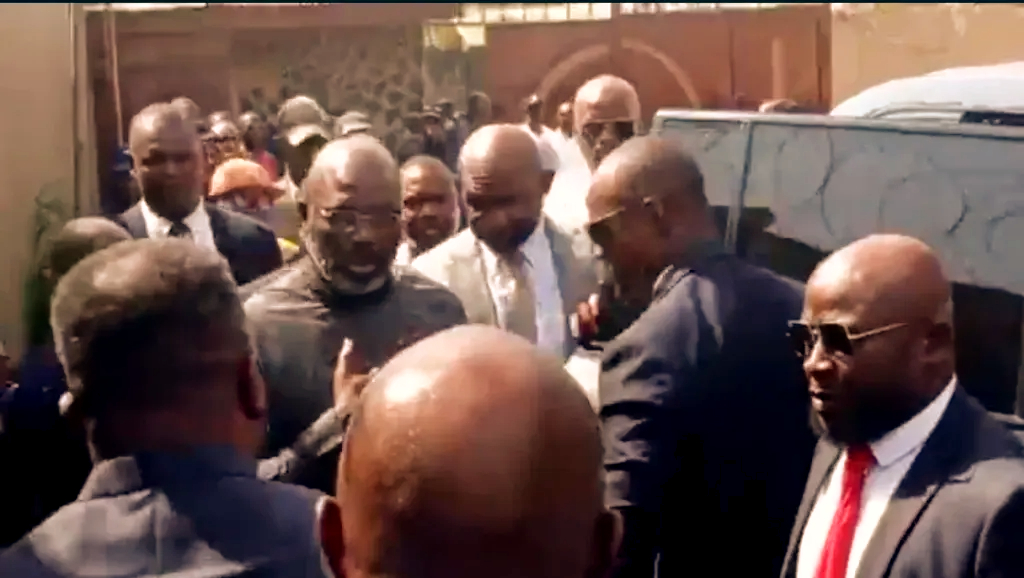
In the intricate theater of Liberian politics, where the spoken word is often guarded and carefully curated, the silent language of gesture has long served as a potent tool for communication. It is a realm where a subtle shift in posture, a lingering gaze, or the deliberate withholding of a traditional greeting can resonate far more profoundly than a formal address. Recently, this silent discourse took center stage during former President George Manneh Weah’s visit to the grieving family of the late political titan and Senator, Prince Yormie Johnson. As Vice President Jeremiah Koung and Representative Samuel Kogar approached to greet the former head of state, Weah opted not to extend his hand.
Instead, he placed his palm firmly over his chest—a gesture that, while seemingly innocuous to an outside observer, sent seismic shockwaves through the local political landscape. This article examines the profound symbolic weight of that moment, unpacking the cultural, historical, and strategic implications of a handshake that never occurred. To understand the gravity of this omission, one must first appreciate the cultural architecture of the Liberian greeting. The handshake in Liberia is more than a mere salutation; it is a profound social contract.
The iconic 'Liberian snap'—a rhythmic exchange that culminates in a sharp, crisp sound—is a hallmark of intimacy, respect, and mutual recognition. By bypassing this established ritual in favor of a hand-on-chest posture, Weah signaled a departure from the warmth expected of high-level political interactions. While some might argue the gesture was a residual practice of COVID-19 safety protocols, the context suggests a more deliberate psychological distancing. This specific movement, reminiscent of the 'dap'—a gesture of solidarity and fraternal commitment originating among Black American soldiers—carries an undertone of selective loyalty.
In the eyes of many Nimbaians, for whom Prince Johnson was a mercurial but essential political lodestar, Weah’s gesture was interpreted as a tacit affirmation of the collective frustration regarding Koung and Kogar. It was a visual shorthand for: 'I stand with those who were loyal, not those who have transitioned.' Liberia’s political history is a tapestry woven with such symbolic threads. The Tubman era, which spanned nearly three decades, established a precedent where political patronage was not merely dispensed through policy but through the meticulous management of non-verbal cues.
William V.S. Tubman mastered the art of the 'political signal,' utilizing the presence or absence of his attention to dictate the professional fates of his subordinates. This legacy of symbolic governance persisted long after his tenure, evolving into a hallmark of the Liberian political class.
We recall, for instance, the palpable tension of the Ellen Johnson-Sirleaf years, where the refusal of a handshake became an unmistakable declaration of war. Whether it was Sirleaf’s cold distancing from Speaker Edwin Snowe or the public defiance of Bhofal Chambers at the National Election Commission’s certification proceedings, these moments were not mere lapses in etiquette. They were calibrated acts of political communication designed to bypass the ambiguity of speech in favor of the clarity of action. By refusing to engage in the customary greeting, Weah tapped into this long-standing tradition of non-verbal exclusion, effectively weaponizing silence.
It is crucial, however, to address the factual nuance of the encounter. While the popular narrative immediately framed the event as a 'snub'—a direct rejection of the Vice President and the Representative—the reality was more nuanced. Neither party reached out; the interaction was one of mutual, chilled stillness. Yet, in the theater of politics, the perception is the reality.
Weah’s calculated posture served to solidify his brand as a leader who refuses to perform civility for those he deems unworthy of it. By positioning his hand on his chest, he claimed a moral high ground, implicitly judging the actions of Koung and Kogar without uttering a single syllable. This provides him with the luxury of plausible deniability; he did not insult them—he merely greeted them in a way that excluded them from the intimacy of his inner circle. The motivations behind this gesture are inextricably linked to the shifting sands of Nimba County politics.
The recent period has been defined by a fracturing of the political base that once unified around Prince Johnson. Leaked audio recordings and public declarations have illuminated a widening chasm between the late Senator and his former proteges, particularly Vice President Koung. The perception that Koung and Kogar abandoned the foundational interests of their mentor in favor of the current Unity Party regime has left a vacuum of resentment in Nimba. Weah, sensing this, has positioned himself as the arbiter of that loyalty.
By aligning his body language with the sentiment of the 'betrayed' Nimbaians, Weah is attempting to reclaim his status as a populist icon who remains in lockstep with the frustrations of the common man. It is a strategic move to preserve his political capital in a region that will undoubtedly play a pivotal role in the future of the opposition. Furthermore, the implications of this incident extend to the impending Nimba senatorial by-election. In a political culture where 'ritual' and 'loyalty' are the primary currencies, the label of an 'opportunist' or 'traitor' is a potent smear.
The visual of Weah shunning Koung and Kogar serves as a rallying point for those seeking to challenge the current regime’s influence in the county. It feeds the narrative that the Vice President and his allies have severed their roots and are adrift from the base that birthed their careers. As the campaign heat rises, this moment will likely be replayed, analyzed, and cited as evidence of the character deficit among those who once stood under the banner of the late Senator Johnson. Weah’s gesture is, in essence, a masterclass in modern political theater.
He has leveraged the rich, historical vocabulary of Liberian non-verbal politics to create a defining image of the current political divide. He has communicated his disapproval, signaled his alliance with the disgruntled faction of the Nimba electorate, and reinforced his own image as a man of principle—all while keeping his hands clean of the fray. The incident serves as a poignant reminder that in the high-stakes world of Liberian governance, silence is rarely empty. It is filled with the weight of history, the sting of betrayal, and the anticipation of what comes next.
Whether this calculated move will translate into tangible electoral shifts or remain a piece of political performance art remains to be seen. However, one thing is certain: the handshake that never was has spoken volumes. It has crystallized the current mood of the electorate and set a tone for the political skirmishes to come, illustrating that in Liberia, sometimes the most powerful statement a politician can make is the one they choose not to say aloud.



