
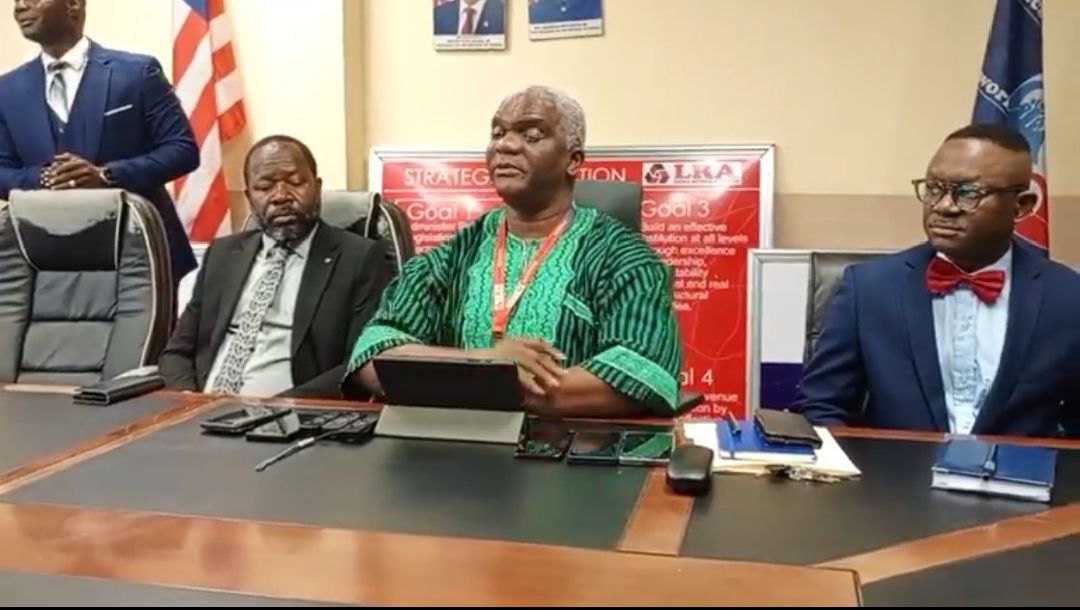
In the ornate halls of the Ministry of Finance and Development Planning, a peculiar narrative of triumph is currently being scripted. On paper, Liberia is ostensibly winning. The recent announcement by Liberia Revenue Authority (LRA) Commissioner General Dorbor Jallah, flanked by his deputies, revealed that domestic tax collections have reached an unprecedented $818 million. This figure cruises past the government’s 2025 revenue target of $804.
6 million, marking a rare feat in the Boakai administration: a tax machinery that is finally, by all technical accounts, firing on all cylinders. This should be a moment of national jubilation, a signpost that the 'ARREST' agenda—Agriculture, Roads, Rule of Law, Education, Sanitation, and Tourism—is being bankrolled by the very people it serves. However, as the curtain falls on the 2025 fiscal year, the celebratory atmosphere at the LRA headquarters feels remarkably hollow to the thousands of teachers, university professors, and health workers who found themselves navigating the Christmas season with empty bank accounts. This is the 'Ghost Surplus,' a phenomenon where the state celebrates macroeconomic milestones while the microeconomic reality for public servants remains one of chronic instability and neglect.
The discrepancy is not merely a bookkeeping error; it is a profound structural failure that threatens to undermine public trust in the state's capacity to govern. The current fiscal architecture relies heavily on domestic resource mobilization, a strategy that has shifted the burden of national development directly onto the shoulders of the Liberian taxpayer. In the 2025 fiscal framework, domestic revenue was not merely a component; it was the backbone of the entire operation. With a total approved budget of $880.
66 million, the $818 million collected signifies that domestic revenue now accounts for nearly 93% of the entire national budget. This shift represents a historic move toward national self-sufficiency, reducing the country's historical over-reliance on external grants and volatile foreign aid. Yet, this achievement serves to sharpen the sting of the current salary crisis. If the nation is now 93% self-funded, why does the most fundamental obligation of the state—paying those who keep the schools open and the hospitals running—remain an unfulfilled promise?
To understand this 'Billion-Dollar Disconnect,' one must look beyond the revenue side of the ledger. While the LRA has successfully acted as a siphon for the national treasury, the Ministry of Finance acts as the regulator of that flow. The current system is plagued by what observers call a 'failed middle,' where the efficient collection of taxes is not matched by the efficient, equitable, and timely distribution of funds to line ministries and agencies. The Boakai administration, which ascended to power on a 'Rescue Mission' platform, now finds itself in a precarious paradox.
By setting even more ambitious targets for the 2026 fiscal year—projecting a budget of $1.211 billion—the government is doubling down on its growth projections. However, history in Liberia shows that larger budgets often beget larger bureaucracies and more complex avenues for administrative leakage. The structural integrity of the Liberian fiscal system has long been challenged by historical factors, including a legacy of civil conflict that eroded institutional capacity and a political culture that often prioritizes patronage over systemic efficiency.
For decades, Liberia functioned as a rentier state, living off the exports of raw commodities and the generosity of international donors. Transitioning to a tax-based economy is a painful but necessary evolution. However, the social contract requires that when the citizen pays, the state delivers. When the state fails to pay its employees on time, it does more than cause personal hardship; it triggers a domino effect.
Civil servants are the engines of the rural economy. When a teacher in Lofa or a nurse in Grand Kru goes unpaid, the local market sees a contraction in spending, which affects local farmers and small businesses. This is not just a 'salary delay'; it is an economic suppression mechanism. The debt servicing burden, estimated at $180 million, consumes approximately 20% of the current budget.
While maintaining international creditworthiness and meeting debt obligations is vital for the nation's long-term fiscal health, it cannot come at the expense of the basic human needs of the civil service. The trade-off between servicing international loans and paying the domestic frontline workforce is a political choice, not just a mathematical necessity. The Boakai administration must reconcile the fact that no amount of revenue collection success will compensate for a demoralized public sector. A teacher who cannot afford transport to the classroom or food for their family is a teacher who cannot effectively contribute to the education sector—a pillar of the President's 'ARREST' agenda.
The Insights Liberia view remains clear: the LRA’s $818 million success is a testament to the resilience of the Liberian taxpayer and the effectiveness of current revenue collection reforms. It is a win for the tax collectors, but a defeat for the governed. The government’s inability to translate these collections into prompt salary payments suggests that the bottleneck is no longer at the point of collection, but at the point of allocation. If the state cannot manage an $800 million flow without triggering a December crisis, then a $1.
2 billion budget in 2026 may not represent a 'rescue'—it may represent a scaling of administrative paralysis. The challenge for the new fiscal year is not simply to collect more, but to account for the 'missing link' in the budget execution process. The President must audit the systems of disbursement. There is an urgent need for transparency in how funds are prioritized once they hit the Consolidated Account.
Is the money being diverted to satisfy procurement contracts of dubious necessity? Is there an excessive amount of 'off-budget' spending that is draining the liquidity intended for payroll? The administration must provide clarity. The era of 'Ghost Surpluses' must end.
Commissioner General Dorbor Jallah has successfully filled the bucket, proving that the Liberian economy has latent potential that can be tapped. Now, the burden of proof shifts to the executive branch. The President must find out who—or what policy—is sitting on the hose that is supposed to distribute this wealth to the people who truly earn it. If the 'Year of the Billion' is to be more than a statistical victory, it must be felt in the bank accounts of the nurses, the police officers, and the lecturers.
Without that, the government risks losing the very constituency that keeps the state functioning. The history of Liberia is replete with examples of governments that celebrated statistical growth while the populace suffered, often leading to deep-seated resentment and institutional collapse. This government has the opportunity to break that cycle by prioritizing people over abstract figures. The tax records are excellent, but the ledger of the soul—the trust between the government and the governed—is currently in the red.
It is time for a policy reset that puts the civil servant back at the center of the fiscal narrative.
