
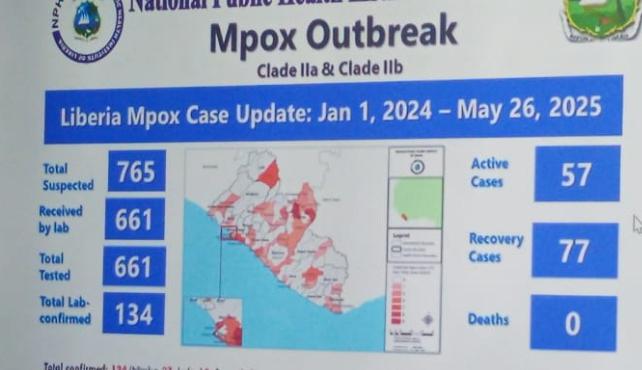
Silent Spread: Liberia’s Mpox Outbreak May Be Worse Than It Seems. Subtitle: Experts fear these numbers may only represent a fraction of the true scale. As of the latest reporting cycle from the National Public Health Institute of Liberia (NPHIL), the nation is grappling with a concerning uptick in Mpox infections. Current data indicates 57 active cases, part of a cumulative total of 134 lab-confirmed infections recorded since January 2024.
While 77 recoveries have been documented, the sheer velocity of transmission within localized clusters has public health experts on high alert. The official figures, while useful as a starting point, are viewed by epidemiologists as a potential underestimate of the true viral footprint within the country. The core anxiety among healthcare stakeholders is that these numbers are merely the tip of a much larger, obscured iceberg. Liberia’s healthcare history, shaped by the brutal lessons of the 2014-2016 Ebola virus epidemic, teaches us that viral outbreaks are rarely static; they are dynamic, often moving through communities long before they are captured by formal surveillance systems.
The potential for 'silent transmission' is the defining crisis of this current outbreak. With 57 active cases, the contact tracing mathematics are daunting. If each patient has had, on average, a handful of close-contact interactions—be they familial, social, or professional—prior to their clinical diagnosis, the chain of transmission potentially encompasses hundreds of exposed individuals who remain unaware of their status. This creates a feedback loop of silent spreading that threatens to overwhelm the already fragile infrastructure of the Liberian Ministry of Health.
The historical context of Liberian public health cannot be ignored. Following the devastating collapse of services during the civil wars and the subsequent trauma of the Ebola crisis, trust in government-led health interventions has been a hard-won commodity. Today, that trust is being tested by the specter of stigma. In many rural and peri-urban communities across Liberia, Mpox, like other infectious diseases before it, is often met with social ostracization.
When a health condition carries the weight of moral judgment or fear, the individual response is almost inevitably avoidance. People showing symptoms—painful lesions, fever, and fatigue—are choosing to hide at home or seek traditional healing methods rather than visiting government-operated clinics where they risk being labeled, shunned, or quarantined. This phenomenon of 'self-isolation out of fear' serves as a massive blind spot for NPHIL and its partners. If symptomatic individuals do not present for testing, the samples simply do not exist to be analyzed.
Consequently, the gap between the official 134 confirmed cases and the true incidence of the disease could be significant. The number of suspected cases, currently standing at 765, provides a more sobering look at the scale of the challenge. With 661 samples tested so far, the testing positivity rate suggests that the virus is actively circulating within the population, finding footholds in communities that may lack the resources for immediate medical intervention. The socio-economic implications of this outbreak are equally profound.
Liberia’s economy is largely driven by trade, agriculture, and informal commerce, all of which require high levels of social interaction. A prolonged Mpox outbreak does not just threaten public health; it threatens the livelihoods of thousands. If schools or markets must be curtailed, or if household breadwinners are sidelined by illness and stigma, the secondary economic impact will be felt by the most vulnerable segments of society. Furthermore, the regional context is alarming.
Liberia is not an island; it exists within a porous West African ecosystem where cross-border migration and commerce are constant. Reports of surges in neighboring Sierra Leone have already caused anxiety among Liberian border authorities. The mobility of the regional population means that pathogens do not respect national boundaries, and any failure to contain the outbreak in Liberia could have cascading effects on the Mano River Union region. The Africa Centres for Disease Control and Prevention (Africa CDC) has been closely monitoring these regional trends, emphasizing that Mpox in West Africa requires a unified, cross-border surveillance strategy.
The declaration of Mpox as a Public Health Emergency of International Concern (PHEIC) by the World Health Organization (WHO) underscores that this is not merely a local nuisance but a global health priority. For Liberia, this international attention brings both resources and expectations. It places pressure on NPHIL to scale up testing, contact tracing, and public awareness campaigns simultaneously. Yet, resources are finite.
The logistical nightmare of reaching remote districts in Liberia with testing kits and, eventually, potential vaccine distribution, is a hurdle that has stalled health efforts in the past. To counter this, NPHIL has been urging the public to treat the virus with scientific seriousness rather than superstitious dread. Misinformation remains a primary adversary. Rumors circulating on social media regarding the nature of the virus, its origin, and the efficacy of vaccines can undo weeks of professional health outreach.
In the Liberian context, the 'infodemic'—the rapid spread of false information—is arguably as dangerous as the virus itself. Education campaigns must be culturally sensitive, utilizing community influencers, traditional leaders, and radio programs to demystify the virus. The goal is to strip away the stigma so that an individual with a fever feels comfortable seeking help, rather than fearing the consequences of a diagnosis. As the situation remains active and concerning, the potential for rapid escalation is clear.
The key to containment lies in transparency. If the government can successfully convince the populace that early testing is a path to healing rather than social exclusion, the surveillance gap will shrink. However, this requires a robust partnership between the state and the people. The citizens must feel that the health system is there to serve them, not to monitor or punish them.
As Insights Liberia has reported previously, historical grievances against state institutions have often manifested as resistance to public health directives. Breaking this cycle requires a radical shift in communication strategies—moving away from top-down mandates toward community-based solutions where local health volunteers are at the forefront of the response. The path forward is steep. With the current testing positivity rates and the high number of suspected cases, the window for containing the outbreak before it enters a phase of widespread community transmission is narrow.
Public health officials are at a crossroads: they can either double down on proactive, community-based surveillance that builds trust and increases reporting, or they can watch as the hidden cases continue to fuel the spread in the shadows. The evidence from the front lines suggests that the virus is finding new hosts every day. Unless the barriers of stigma and misinformation are dismantled, Liberia could be facing a much larger and more challenging health crisis than current figures reveal. The responsibility now lies not only with policymakers but with every Liberian to remain vigilant, report symptoms immediately, and reject the fear that isolates the sick from the care they so desperately need.
This outbreak serves as a stark reminder of the fragile balance of post-conflict recovery and the constant, silent threats that modern societies face. For Liberia, the lesson of 2024-2025 will be defined by its ability to act with transparency and collective resolve in the face of an invisible, yet potent, adversary.
