
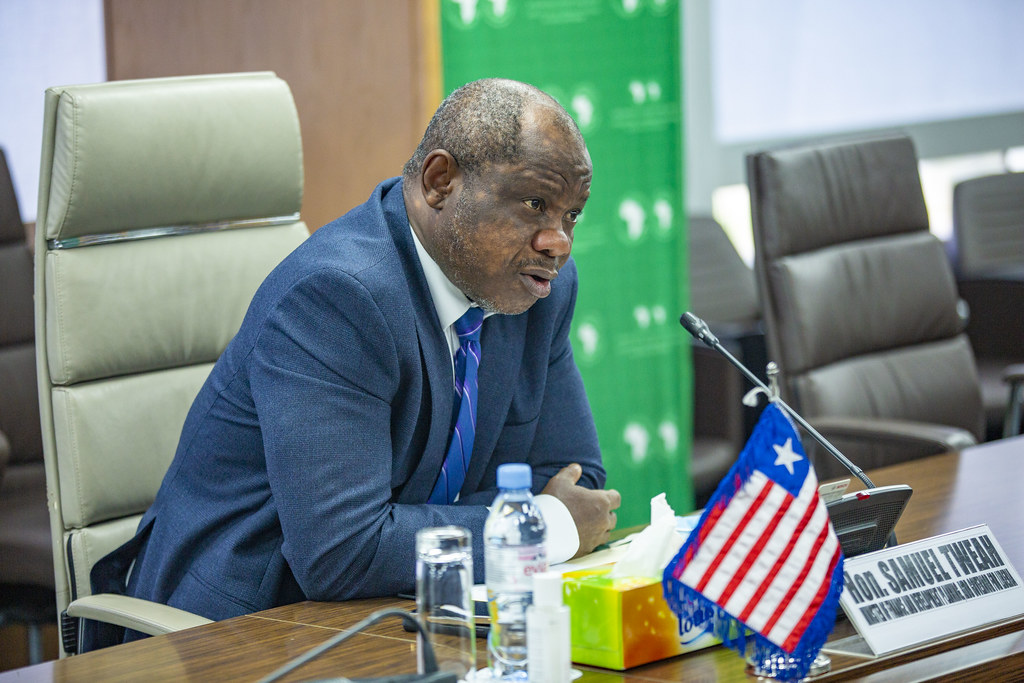
In the complex theater of Liberian political discourse, few exchanges have been as intellectually charged and politically consequential as the recent public sparring between current Minister of Finance and Development Planning, Samuel D. Tweah, and his predecessor, former Minister Amara Konneh. What began as a series of policy critiques regarding the management of the state's coffers quickly spiraled into a comprehensive post-mortem of financial governance, legislative procedure, and the ethical conduct of public servants in the post-war era. For Insights Liberia, this collision serves as a prism through which we can examine the structural vulnerabilities of our fiscal systems and the often-shadowy intersections of private wealth and public duty.
Tweah, adopting a professorial and often cutting tone, has systematically sought to dismantle the narrative of superiority that Konneh has frequently projected regarding his tenure in the Sirleaf administration. At the heart of this confrontation is the question of who truly understands the mechanics of the Liberian state—a debate that touches on the very survival of our national economy. The Framework Document, often discussed in dry policy circles, has become the centerpiece of this battle. Tweah’s core argument rests on a blistering critique of Konneh’s grasp of constitutional and statutory financial procedures.
Specifically, Tweah points to the ambiguity surrounding the requirement of legislative ratification for certain financial receipts and obligations. This is not merely an academic disagreement; it is a fundamental challenge to the precedent set during the Unity Party’s twelve-year governance. Tweah has highlighted the 2013 issuance of LRD $6 billion in Treasury bills, which notably bypassed full legislative ratification. By drawing this historical parallel, Tweah is not just defending his current policies; he is exposing a pattern of executive convenience that arguably predates his own appointment.
This move forces the public to ask a difficult question: if legislative oversight was considered fluid or optional in the past, why is it being treated as a sacred ironclad requirement only when the opposition is in power? The implications of this are profound, suggesting that the critique of governance is often a weaponized tool of political branding rather than a sincere pursuit of institutional integrity. Furthermore, the debate over legal terminology, specifically the concept of 'liquidated damages' within the HPX agreement, reveals a deeper disconnect in public policy literacy. Konneh’s portrayal of these contractual stipulations as an anomaly or a sign of corruption was met with a clinical deconstruction by Tweah.
By clarifying that liquidated damages are, in fact, standard, predefined contractual penalties designed to mitigate risk in government infrastructure projects, Tweah shifted the burden of proof back onto his accuser. For the casual observer, this may seem like technical jargon, but for the economist and the policymaker, the distinction between a court-ordered compensation—which implies wrongdoing or failure—and a liquidated damage clause—which is a prophylactic contractual tool—is vital. This exchange highlights a recurring issue in Liberian public discourse: the tendency to characterize complex economic arrangements as evidence of malfeasance to score political points, thereby obfuscating the actual administrative challenges of attracting foreign investment to a developing economy. Beyond the technical, the dispute has descended into the deeply personal, as Tweah has openly questioned Konneh’s professional competence and his accumulation of assets.
This is where the narrative shifts from fiscal policy to the broader crisis of ethics in Liberian governance. Tweah’s accusations regarding Konneh’s departure from the World Bank and the subsequent acquisition of a $7 million farm and a $3 million property are significant. They touch a raw nerve in a country where the 'gap' between a civil servant’s official salary and their sudden lifestyle transformation remains a source of public frustration. Insights Liberia has received a trove of documentation and informant tips that suggest Tweah’s claims regarding these assets are not merely rhetorical flourishes; they represent a potential powder keg of public integrity investigations.
If a former minister can amass multi-million dollar holdings, the question of whether this was enabled by his stewardship of the national treasury is a matter of urgent public interest. This aspect of the debate forces us to look past the policy spreadsheets and into the reality of asset declaration and the lack of robust enforcement by the Liberia Anti-Corruption Commission (LACC). The international context of this debate cannot be overstated. Tweah has leaned heavily on Liberia’s performance metrics under various international financial programs to validate his governance model.
He argues that the macro-fiscal stability achieved under his watch is documented and verified by external partners like the IMF and the World Bank. Conversely, Konneh has historically leaned on his pedigree within these same institutions to claim a monopoly on expertise. Tweah’s counter-argument is that international assessments are not just benchmarks for loans but are reflections of a more holistic approach to domestic transparency and public information accessibility. He is essentially arguing that the 'new' way of managing Liberia’s finances is more attuned to global best practices than the 'old' way, which he characterizes as relying on institutional name-dropping rather than actual data transparency.
This clash is illustrative of a wider regional trend where post-conflict nations struggle to transition from 'patronage-based' financial management to 'rule-based' systems. The historical context of the Liberian economy—characterized by cycles of commodity-dependent growth and severe fiscal shocks—demands a level of continuity that our political culture rarely affords. When political figures engage in such public acrimony, it risks undermining investor confidence and the delicate relationship with our multilateral partners. However, in this specific case, the aggressive scrutiny by Tweah serves a necessary function: it forces the 'experts' of the past to account for their records.
We believe that Tweah’s approach, while undeniably combative, has been effective in shedding light on the mechanics of our fiscal governance. He has challenged the myth of the infallible technocrat. By forcing a debate on the specificities of legislative ratification, contractual law, and the veracity of personal wealth, Tweah is shifting the standard for what is expected of those who have held the nation’s purse strings. As an investigative platform, we at Insights Liberia find that this exchange underscores a critical reality: the battle for Liberia’s future is not just about who holds power, but about who can define the standards of accountability.
The challenge for the Liberian public is to sift through the rhetoric and demand that these high-level debates translate into tangible changes in how our public resources are managed. We need more than just 'schooling' in the public square; we need a consistent application of the law, regardless of which party is in power. The questions raised about Konneh’s assets are symptomatic of a deeper, long-standing issue of accountability that has persisted across multiple administrations. Until such time that our institutions can independently audit, investigate, and if necessary, prosecute high-ranking officials for unexplained wealth, such public spats will remain the only venue for seeking truth.
We believe that the ongoing dialogue between Tweah and Konneh, while fraught with political animosity, serves as a vital case study in the necessity of transparency. It is a reminder that the history of our fiscal governance is written in both the decisions of the past and the accountability measures of the present. As we look forward, the critical metrics of success will remain domestic fiscal stability, the integrity of our public institutions, and the unflinching courage of those willing to hold the line against historical patterns of fiscal opacity. This is the new standard of engagement that Liberians must demand.
