
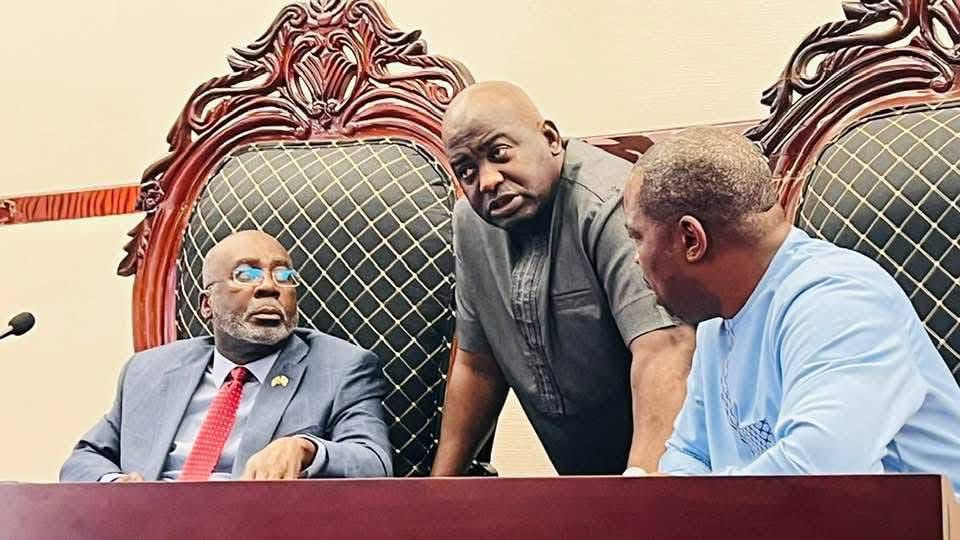
In a seismic development that threatens to upend the foundational pillars of Liberia's fragile democratic experiment, the newly formed Rule of Law Caucus has officially announced its intention to boycott President Joseph Nyuma Boakai's inaugural State of the Nation Address (SONA). This high-stakes maneuver, spearheaded by the influential and outspoken Chairman Musa Hassan Bility, represents far more than a simple legislative disagreement; it serves as a glaring symptom of a deepening, multifaceted crisis currently paralyzing the country's legislative branch. As the nation watches with bated breath, this standoff highlights the acute friction between the Executive Mansion and the Capitol Building, portending potential, long-term gridlock that could derail the administration’s core policy objectives and erode public trust in government institutions. The crux of this volatile dispute lies in a contentious, unresolved struggle over the speakership of the House of Representatives.
Despite the incumbent Speaker, J. Fonati Koffa, continuing to assert his legal and constitutional authority, the Executive branch has chosen to extend recognition to Hon. Richard N. Koon as the legitimate leader of the lower house.
This executive endorsement is viewed by the Rule of Law Caucus not merely as a political preference, but as a flagrant, unconstitutional breach of the sacred principle of legislative autonomy. The caucus argues that the President has overstepped his constitutional bounds by attempting to influence, or even dictate, the internal leadership structure of a co-equal branch of government. This action, according to the caucus, strikes at the very heart of the separation of powers—a doctrine specifically designed to prevent the concentration of authority in a single office. Historically, the struggle for legislative independence has been a recurring theme in Liberian politics.
From the post-civil war recovery years to the present, the National Legislature has frequently contended with the shadow of the Executive Mansion. The current impasse, however, is unique in its intensity and its immediate challenge to the recognized legal processes. By choosing to boycott the SONA, a constitutional requirement where the President reports to the legislature, the caucus is effectively weaponizing their absence to deny the President the ceremonial legitimacy he seeks. This act of protest is a profound signal that the legislative branch is deeply fractured, and that the rule of law is being tested in real-time.
The caucus’s hard-hitting press release pulls no punches, accusing the Executive of systematically undermining democratic principles and humiliating the Legislature as an institution. They argue that by acknowledging an alternative leadership, the administration has effectively signaled that political convenience trumps the established legal protocols of the House. For a nation that has spent decades striving for institutional maturity, this public display of discord is profoundly destabilizing. The timing of this boycott is particularly potent, calculated to maximize political impact on the eve of the SONA.
Traditionally, the SONA is the most significant platform for a President to articulate his vision, outline legislative priorities, and solidify his public agenda. By choosing to withhold their presence, the caucus is effectively throwing a major spanner in the works of President Boakai's administration. The boycott risks overshadowing any policy announcements with the high-stakes drama of a constitutional showdown. Moreover, this move signifies a dangerous escalation in the power struggle.
The caucus’s steadfast refusal to acknowledge Richard Koon’s authority, pending a definitive judicial ruling from the Supreme Court, casts a cloud of illegitimacy over any legislative proceedings he might oversee. If laws are passed or budgets approved under a disputed speakership, the nation faces the prospect of protracted legal challenges that could grind government operations to a complete standstill. The economic implications are dire; investor confidence is intrinsically linked to the stability of the rule of law, and a paralyzed legislature that cannot function legitimately risks alienating the international donor community and discouraging foreign direct investment. Furthermore, the situation is exacerbated by swirling, serious allegations of aggression against caucus members by state security and law enforcement personnel.
These claims, if substantiated, provide a chilling glimpse into a potential shift toward stronger, more autocratic governance styles. Should the Executive be proven to be utilizing state apparatuses to intimidate political opponents, it would represent a significant backslide for Liberia’s hard-won democratic progress. Such tactics have the potential to spark civil unrest, as the electorate becomes increasingly wary of perceived authoritarian overreach. The caucus has framed their position not as an act of mere political defiance, but as a moral, principled stand in defense of democratic norms.
This narrative positioning is a masterstroke in political communication, designed to resonate with a populace that has historically shown a deep suspicion of centralized power. By invoking the “rule of law” and “democratic governance,” the caucus is claiming the moral high ground in a conflict that is as much about perception as it is about power. Their call for solidarity from senators and other lawmakers is an attempt to galvanize a broader coalition of resistance. If the caucus succeeds in broadening this movement, it could precipitate a full-scale legislative revolt, fundamentally altering the dynamic between the President and the legislative body for the remainder of the term.
For political observers, this standoff evokes echoes of past legislative crises, drawing parallels to times when constitutional friction pushed Liberia to the brink. These historical precedents serve as a reminder that the stability of the Liberian republic is fragile and requires constant, careful navigation. The current crisis is being closely monitored by regional bodies like ECOWAS and international observers, who are acutely aware that the stability of Liberia is vital to the stability of the West African sub-region. The language used in the caucus's official communications—terms like “erosion of legislative independence” and “blatant violation of democratic principles”—is explicitly chosen to frame the narrative for a domestic and international audience.
This is a battle for the soul of the institution, and the rhetoric suggests that the caucus is prepared for a prolonged struggle. The news value of this situation is immense, as it encompasses all the elements of a classic political crisis: conflict, the participation of high-ranking figures, intense time pressure, and severe consequences for the governance of the nation. As the date of the address approaches, all eyes remain fixed on President Boakai. His response to this boycott will be a defining moment for his administration.
Will he seek a path of dialogue and compromise to restore the functioning of the House, or will he double down on his recognition of the current bloc, risking a permanent rift with the caucus? The path he chooses will define his legacy and determine whether his presidency will be remembered for strengthening democratic institutions or for the erosion of the checks and balances that hold the Liberian government accountable to its people. The stage is set for a dramatic, potentially transformative chapter in the nation's political trajectory.
