
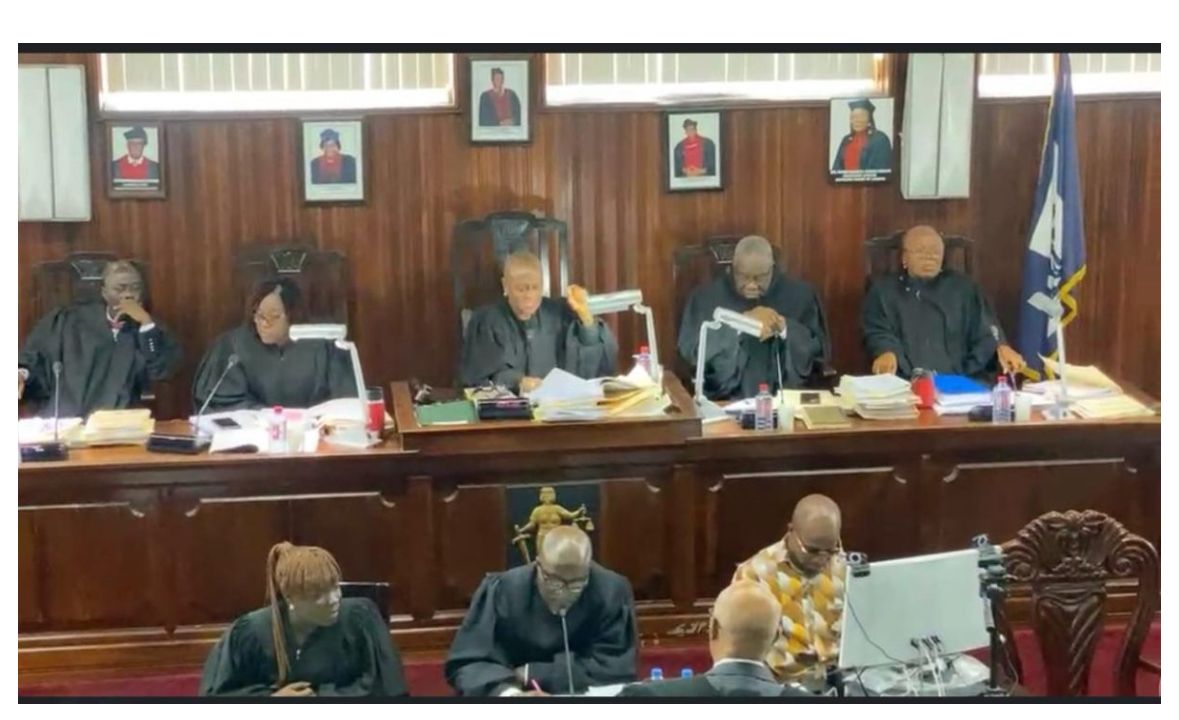
In a display of judicial resolve that echoes through the corridors of the Temple of Justice, the full bench of the Supreme Court of Liberia has reaffirmed its role as the ultimate arbiter of constitutional truth. This recent intervention, marked by a stern rebuke of the so-called 'Majority Bloc' in the House of Representatives, signals a pivotal moment for Liberia’s fragile democratic experiment. As Chief Justice Sie-A-Nyene Yuoh presided over the proceedings, the message was unmistakable: procedural integrity is not a suggestion but a bedrock requirement for the functioning of a constitutional republic. The Chief Justice underscored that the removal of a Speaker of the House is not a political game to be won through brute force or backroom maneuvering; it is a solemn legislative act governed by rigid constitutional mandates, requiring both a legitimate quorum and the requisite 49 votes.
This stance is a vital defense against the creeping erosion of democratic norms that has characterized recent political posturing in Monrovia. By demanding that all legislative actions align with the spirit and letter of the law, the Court is acting as a necessary circuit breaker in an environment where political expediency has increasingly prioritized personal interests over the national mandate. The Court’s criticism of the Majority Bloc, which has persisted in operating parallel sessions, was both piercing and unequivocal. This legislative insurgency—whereby a group of lawmakers attempts to bypass the recognized presiding officer—represents a direct challenge to the established order.
By fostering parallel governance within the Capitol, the Bloc has not only violated fundamental constitutional provisions but has also invited a state of institutional incoherence that threatens to paralyze the government. The Supreme Court correctly identifies this as a 'recipe for chaos,' a term that resonates with those who recall the historical fragility of Liberian institutions. When legislative bodies bypass their own bylaws to satisfy immediate political objectives, they set a dangerous precedent that suggests the law is malleable rather than binding. The irony is palpable: those tasked with drafting the laws of the nation are the very ones demonstrating a disregard for them.
Central to this legal and political imbroglio is the Court’s pointed reference to Representative Samuel Kogar (or similar figures identified in the Bloc’s maneuvering) as the 'purported Speaker.' This deliberate linguistic choice is not merely symbolic; it is a formal declaration of illegitimacy. It aligns perfectly with the Court’s historical posture that any action failing to conform to Articles 33 and 49 of the 1986 Constitution—the guiding document of Liberia's Second Republic—is ultra vires, or beyond the scope of legal authority. Article 33 explicitly defines the requirements for a quorum, while Article 49 outlines the process for electing and removing the Speaker.
By ignoring these foundations, the Majority Bloc has effectively entered a legal vacuum where their decisions hold no more weight than the paper they are written on. Justice Yusuf Kaba, whose interventions have provided some of the most intellectual depth to these proceedings, issued a stark warning regarding the potential for anarchy. He posited that if the Court were to allow a simple majority to bypass a presiding officer whenever they felt dissatisfied, the result would be the inevitable collapse of the legislative branch. History provides a somber backdrop to such concerns; Liberia has long struggled with the consolidation of power, and the temptation to bypass traditional checks and balances remains a hallmark of political instability.
Justice Kaba’s warnings serve as a reminder that the stability of the state rests upon the predictability of its processes. If the rules change based on who is in the room, the rules cease to exist. The hearing, however, was not merely a dry exercise in legal theory. It was marred by reports of high-stakes contamination, specifically allegations of attempted bribery directed at members of the Supreme Court.
Wealthy backers, reportedly aligned with the Bloc, have allegedly sought to purchase the judicial outcomes they could not secure through legitimate constitutional means. These allegations cast a dark, suffocating shadow over the proceedings, threatening the already strained public trust in the judicial system. In a country where corruption has historically been a tool for political survival, these reports are particularly damaging. They suggest that the legislative crisis is not merely a dispute over procedure, but a battle for the soul of the judiciary itself.
The Court’s request for increased security for its Associate Justices speaks volumes about the volatile nature of the current political climate. The atmosphere in Monrovia is fraught with apprehension as the citizenry watches to see if the rule of law will prevail over the pressure of political patronage. The implications of the Court’s final ruling extend far beyond the immediate fate of Speaker Fonati Koffa. This case serves as a litmus test for the balance of power between the Executive, Legislative, and Judicial branches.
If the Court yields to the Majority Bloc, it risks signaling that any determined faction can hold the state hostage through extra-constitutional means. Conversely, by holding the line, the Supreme Court protects the sanctity of the legislature from those who would use it as a weapon to silence opposition. Furthermore, the economic implications cannot be overstated. A government in constant state of internal war cannot effectively implement its budget, pass needed development bills, or attract the foreign investment necessary to alleviate the poverty that continues to plague the Liberian populace.
Stability is the precursor to development, and the current 'recipe for chaos' is an impediment to the national growth agenda. As stakeholders look to the future, this crisis serves as a poignant reminder that Liberia’s democratic transition is not a destination but a continuous, often grueling, process of reinforcement. The legacy of the 1986 Constitution is being tested in real-time, and the Supreme Court stands at the center of this firestorm. Whether the Court eventually solidifies the Speaker’s position or insists on a restart of processes, the precedent established here will dictate the trajectory of Liberian politics for years to come.
Will we continue to slide toward a system where might makes right, or will we return to the strict, often tedious, adherence to the rule of law? The silence of the bench as they reserve their ruling is the sound of a nation waiting for its democratic foundation to be either reinforced or fractured. For the observers at Insights Liberia, the takeaway remains clear: justice must be blind, impartial, and utterly insulated from the influence of the political elite. Only then can the House of Representatives hope to reclaim its status as a house of laws, and only then can Liberia move past the recurring cycle of crises that have hindered its progress for so long.
The eyes of the nation remain fixed on the Temple of Justice, awaiting a verdict that will either douse the flames of political volatility or permit the embers of chaos to consume the legislative framework.
