
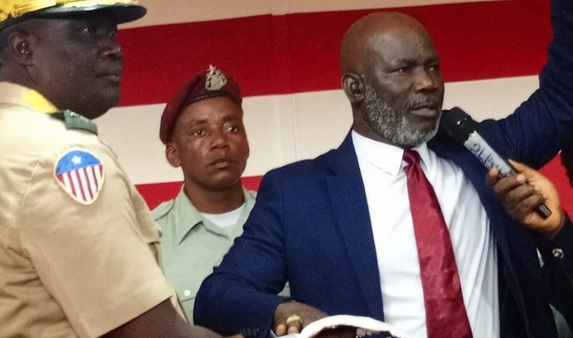
The political architecture of Liberia is currently undergoing a stress test of historic proportions. The recent upheaval within the House of Representatives, marked by the attempt to oust Speaker J. Fonati Koffa and the subsequent election of Representative Richard Nagbe Koon, represents more than a mere power struggle; it is a profound collision between parliamentary pragmatism and constitutional rigidity. As the nation watches, this legislative gridlock has raised fundamental questions regarding due process, the interpretation of standing rules, and the sanctity of constitutional norms.
To understand the gravity of the situation, one must look beyond the surface-level political maneuvering and analyze the structural tensions that have brought the Liberian legislature to this precarious juncture. The crisis, which effectively paralyzed the House for weeks, began to reach a fever pitch on November 21, 2024. During a session convened in the joint chamber of the Capitol Building, a coalition of lawmakers identifying themselves as the 'Majority Bloc'—numbering over thirty-nine members—took the unprecedented step of declaring the Speaker’s position vacant. This action, orchestrated in the absence of the sitting Speaker, was positioned as an exercise in legislative oversight.
However, critics were quick to highlight that the manner of its execution appeared to circumvent the established legislative protocols designed to protect the office of the Speaker from arbitrary removal. The selection of Richard Koon, a Unity Party representative for District 11, Montserrado County, was intended to signal a new mandate. Yet, the legitimacy of this transition remains the central point of contention, complicated by the fact that several lawmakers eventually rescinded their signatures from the resolution, casting doubt on the stability of the coalition that propelled the change. The move to unseat Speaker Koffa was not a spontaneous outburst but the culmination of months of simmering discontent.
The allegations levied against the Speaker were multifaceted, touching upon both ethical conduct and administrative management. Central to the accusations was the issue of financial stewardship. Members of the Majority Bloc alleged that Koffa had engaged in massive budget manipulation, particularly during his tenure as Deputy Speaker. Specific claims suggested that his office had accessed over $9 million in funding against an allocation of roughly $2.
6 million, a discrepancy that the bloc argued constituted a clear pattern of financial misconduct. Furthermore, the Speaker was accused of presiding over unauthorized plenary sessions, effectively insulating himself from the very legislative oversight he was sworn to facilitate. By allegedly refusing to honor invitations from specialized committees tasked with investigating these financial and administrative claims, the Speaker was portrayed by his detractors as acting with total impunity—a charge that became the foundational argument for his removal. Additionally, the suspension of specific lawmakers without what the opposition described as 'due process' and the unilateral restructuring of statutory committees served as catalysts for the revolt.
The Majority Bloc argued that these actions violated both the House Standing Rules and the Liberian Constitution, effectively turning the House into a space governed by the preferences of an individual rather than the collective will of the body. The legal fallout from this crisis was swift. Speaker J. Fonati Koffa, refusing to acknowledge the validity of his removal, mounted a vigorous legal defense by petitioning the Supreme Court of Liberia.
The petition, presided over by Chief Justice Sie-A-Nyene G. Yuoh, framed the actions of the Majority Bloc as a direct affront to the constitutional order. The arguments presented by the petitioners were substantive, focusing on the procedural illegalities they alleged occurred. First, they argued that Deputy Speaker Thomas Fallah and his allies held sessions without the authority of the Speaker, thereby violating Rule 10 of the House’s Standing Rules, which grants the Speaker sole power to call and preside over sessions.
They contended that because no valid vacancy had been declared in accordance with the law, these sessions were legally null and void. Second, the petition addressed the issue of arbitrary suspensions. By citing Article 20 of the Constitution and Rule 48 of the House Standing Rules, the legal team argued that the suspension of Representatives Edward Flomo, Abu Kamara, and Marvin Cole was performed without the requisite disciplinary investigations or hearings, thereby stripping them of their rights as elected representatives. Third, the petition challenged the restructuring of statutory committees.
According to Rules 54.1 and 54.2, committee chairs serve three-year terms and can only be removed for cause by a two-thirds majority vote. The petitioners argued that the Majority Bloc’s failure to adhere to this threshold invalidated their committee reassignments.
Perhaps most critical to the nation’s governance was the accusation that the bloc had unlawfully seized control of the 2025 draft national budget. The petitioners argued that such a seizure undermined the Speaker's constitutional duty to oversee the budgetary process, creating a chaotic environment for fiscal planning at a time when the government is already struggling with complex economic realities. Ultimately, the Koffa camp leaned heavily on Article 49 of the Constitution, which demands that the removal of a Speaker must be rooted in clearly defined procedures, a fair hearing, and a definitive two-thirds majority vote. Their plea to the Supreme Court was to serve as the final arbiter—to strip away the political labels and determine whether the legislative branch has the power to ignore its own rulebook in the pursuit of political goals.
The societal and political ramifications of this saga extend far beyond the walls of the Capitol. The election of Richard Koon has created a binary reality in the minds of the public and the political elite: one side views it as a necessary act of legislative house-cleaning, a triumph of reform over entrenched interests; the other views it as a dangerous precedent, where the majority can simply rewrite the rules of governance whenever it becomes politically convenient to do so. This, in essence, is the core of the danger. When the legislature enters a state of perpetual litigation and contestation, the actual work of the people—the passage of laws, the oversight of the executive, and the response to national crises—is inevitably delayed or abandoned.
The indecision and internal strife have left the House of Representatives in a state of suspended animation, where every decision is questioned and every action is challenged in court. This crisis is a mirror reflecting the broader challenges of building democratic institutions in a post-conflict society. It demonstrates that the mechanisms of governance, while formally defined on paper, require a consistent culture of adherence to prevail in practice. Without this culture, the law becomes a tool to be exploited rather than a safeguard to be respected.
As we look toward the potential outcomes of the Supreme Court rulings, it is clear that the decision will serve as a seminal moment for Liberian democracy. It will either reaffirm the supremacy of constitutional processes and check the ambitions of factions, or it will create a 'winner-takes-all' environment where the legislative process becomes subservient to the transient whims of whoever can command the most signatures on any given day. In the meantime, the political temperature remains high. The withdrawal of signatures by several lawmakers indicates that the Majority Bloc is not as monolithically united as its initial display of force suggested.
This, combined with the ongoing legal challenges against Representative Koon’s legitimacy, ensures that this chapter in the House of Representatives is far from closed. For the people of Liberia, this is a time for vigilance. The stability of the state rests on the belief that its leaders operate within a framework that is transparent, predictable, and fair. When that framework is cracked, the resulting political insecurity threatens not just the individuals involved in the dispute, but the very functioning of the government.
The path forward demands more than just a judicial resolution; it requires a renewed commitment to legislative dialogue, a respect for the established rules of engagement, and a recognition that the authority of a Speaker is derived from a process that must, above all else, be constitutional. Only by subordinating personal and factional interests to the spirit of the law can the House regain the public trust it has so clearly lost during this tumultuous period. The coming weeks will test the resilience of Liberia’s democratic institutions as they navigate this transition, and the ultimate resolution will determine whether the legislature emerges stronger and more accountable, or whether it remains trapped in a cycle of instability that risks the progress of the nation.
