
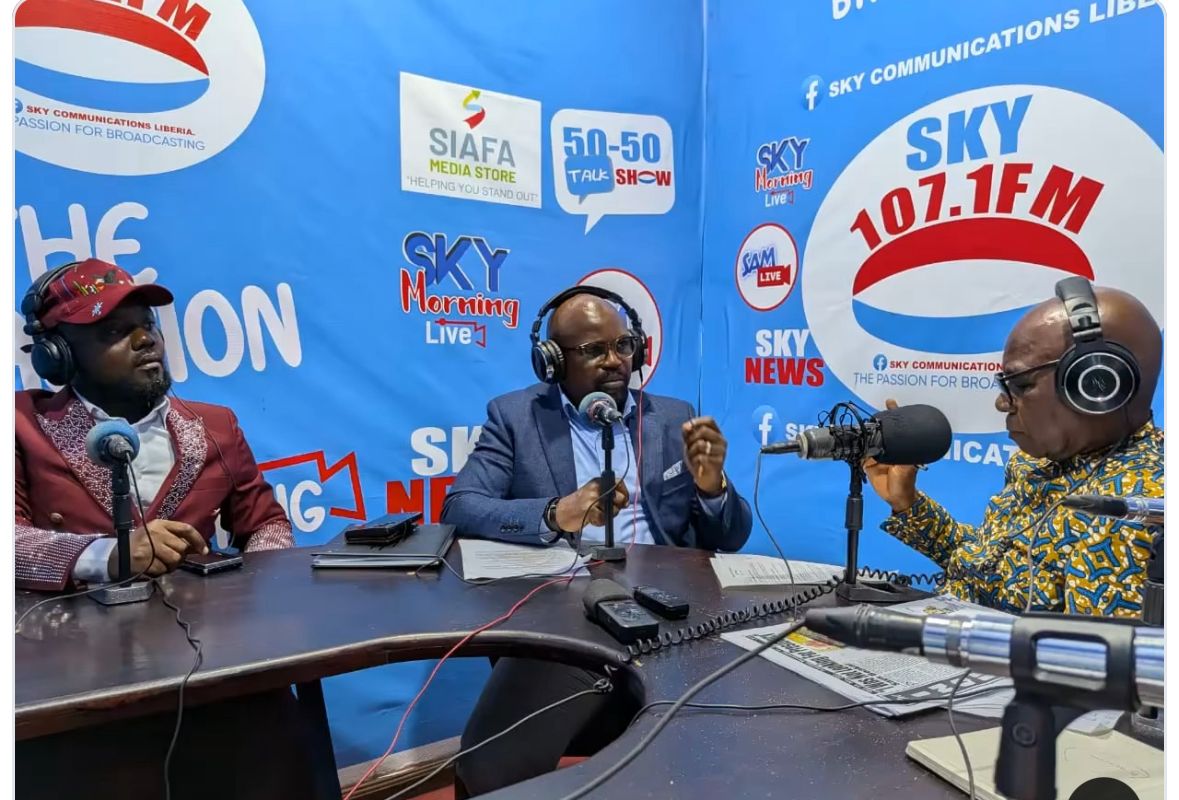
The sprawling, multi-million-dollar villa emerging from the verdant landscape of Foya, Lofa County, has become more than just a piece of architectural wonder; it has transformed into a profound symbol of the opaque nature of governance in modern-day Liberia. As the structure continues to rise, it serves as a haunting reminder of the disconnect between the ruling elite and the impoverished citizenry, standing as a monument to questions that the administration of President Joseph Nyuma Boakai seems desperate to avoid. When a project of this magnitude—allegedly valued at $10 million—is shrouded in claims of national security, it raises the inevitable concern that the state is not protecting the nation, but rather shielding itself from the scrutiny of the governed. The recent appearance of Public Works Minister Roland Giddings on the popular “50/50” radio program, hosted by the intrepid Julius Jeh, provided a window into this culture of evasion.
When confronted with direct questions regarding the ownership, funding, and construction of this massive facility, Minister Giddings retreated behind a wall of vague bureaucracy, citing “national security implications.” This response is not merely a non-answer; it is a tactical withdrawal from the mandate of transparency that the Ministry of Public Works is constitutionally obligated to uphold. To claim that a residential villa—regardless of its intended use—falls outside the purview of the ministry responsible for the nation’s infrastructure and construction standards is an affront to the intelligence of the Liberian public. This evasion confirms a disturbing trend: when faced with the hard realities of accountability, the current administration prefers to cloak its activities in the fog of security, a term that has become a convenient umbrella for silencing debate and preventing the disclosure of financial malfeasance.
The context of Lofa County, President Boakai’s home turf, cannot be ignored. Historically, Lofa has been a stronghold for political power, yet it remains plagued by some of the highest poverty and infrastructural deficits in the country. The visual of a $10 million palace rising in an area where citizens struggle for basic access to clean water, electricity, and reliable roads is not just a political faux pas; it is a moral catastrophe. The silence from the local leadership, specifically the Superintendent of Lofa, who confessed to having no knowledge of the project, underscores the lack of decentralization and local inclusion in high-level government decision-making.
If the local government, which operates on the ground, is kept in the dark about a project of this scale, then who is actually calling the shots? The pattern of official contradictions regarding the villa’s origin is arguably more damaging than the silence itself. Initially, Deputy Information Minister Daniel Sando attempted to link the project to the Mano River Union (MRU), an intergovernmental organization that fosters economic cooperation between Liberia, Sierra Leone, Guinea, and Côte d’Ivoire. However, this narrative collapsed when the MRU issued a categorical denial, confirming they had no financial or administrative involvement in the construction.
This pivot to an international body as a convenient cover story suggests a level of desperation, if not outright deceit, in the government’s communications strategy. When the MRU denied the claim, the government was left without a financier, leaving the public to speculate on the true source of the funds. This is not merely an administrative error; it is a classic indicator of the misappropriation of state resources. When Presidential Press Secretary Kula Fofana claimed the structure was a government asset intended for presidential use, the ambiguity only deepened.
If it is a government asset, where is the legislative appropriation? Where is the bidding process as mandated by the Public Procurement and Concessions Commission (PPCC) Act? Without a budget line, without a procurement record, and without a clear contract, the villa exists in a legal vacuum. In a country that has struggled with systemic corruption for decades, these red flags are impossible to ignore.
The history of Liberia is littered with projects that began under the guise of “national development” only to be revealed as conduits for money laundering or the personal enrichment of political actors. The Foya villa invites comparisons to the unchecked spending of previous administrations, proving that while the faces in the Executive Mansion may change, the mechanisms of influence-peddling and resource diversion remain disturbingly resilient. The lack of transparency suggests that the funds used to construct this facility did not pass through the traditional, audited channels of the national budget. This raises critical questions: are we seeing the diversion of ministerial budgets?
Is there an influx of ‘gift’ money from private interests seeking influence within the Boakai administration? Or is this a case of the state’s coffers being treated as a private bank account by a small clique of high-ranking officials? The broader regional significance of this scandal cannot be overstated. Liberia currently sits at a precarious economic juncture, relying heavily on international aid and trying to attract foreign direct investment to jumpstart its struggling economy.
When high-level officials fail to provide accountability for such an obviously significant financial undertaking, it signals to international partners that the climate for business in Liberia remains tainted by corruption. If the government cannot account for a villa in its own backyard, why should the international community trust it with development grants or loan facilities? The social implications are equally dire. In a country where civil servants are often delayed in receiving their salaries, the spectacle of a multi-million-dollar project being built under the cover of darkness fuels public resentment.
It erodes the social contract, creating a sense of betrayal among the youth and the working class who were promised change, transparency, and integrity. The government’s attempt to characterize the villa as a matter of “national security” is, in reality, a form of intellectual gaslighting. It assumes the public is incapable of understanding the difference between sensitive intelligence operations and private residential construction. This dismissive attitude toward the electorate is what breeds the cycle of mistrust that has hampered Liberian politics for generations.
For the journalists at Insights Liberia and the broader independent media, the Foya villa is not just a building; it is a test of the administration’s commitment to its own promises. President Boakai campaigned on a platform of anti-corruption and the rule of law. If the administration continues to shield its officials from accountability, and if it continues to allow the Ministry of Public Works to deflect its responsibilities, then the legacy of this government will be defined not by the progress it made, but by the corruption it enabled. The truth about the Foya mansion will eventually surface, as history shows that such deep-seated contradictions cannot be buried forever.
The longer the government remains silent, the more the public will associate the villa with the darker aspects of governance: greed, betrayal, and the fundamental rot of public trust. Until a transparent accounting is provided—including the original budget, the tender documents, and the source of funding—this mansion will remain a symbol of everything that is wrong with the way Liberia is being governed. The people of Liberia deserve more than evasive answers and national security excuses; they deserve the truth about how their country’s resources are being utilized. Anything less is a betrayal of the public trust that the current administration was sworn to protect.
