
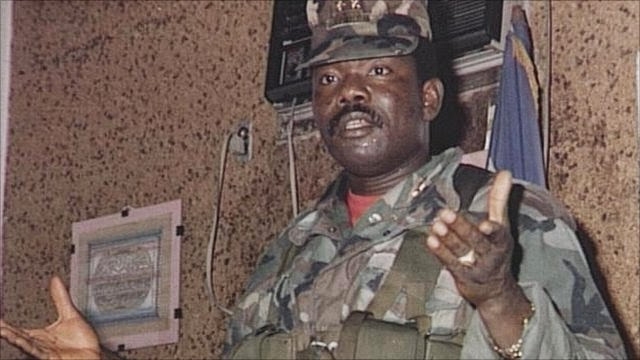
The death of Prince Yormie Johnson on November 28, 2024, at the age of 72, resonates far beyond the confines of his Nimba County stronghold. As one of the most enigmatic and feared figures in Liberia’s modern history, Johnson’s passing serves as a watershed moment for the nation, particularly concerning the long-gestating War and Economic Crimes Court (WECC). His life, defined by the brutality of the civil war and a subsequent, improbable transformation into a kingmaker in the Liberian Senate, embodies the unresolved trauma and systemic impunity that have plagued the country since the 1989 rebellion. With his exit from the political stage, the path toward judicial accountability for the quarter-million souls lost during the conflict is suddenly, and irrevocably, altered.
To understand the gravity of this moment, one must look back at the origins of the conflict that defined his legacy. The Liberian Civil War was not merely a local rebellion but a seismic rupture in the nation’s social contract. When Charles Taylor launched his insurgency in December 1989, it aimed to topple the autocratic regime of Samuel Doe. However, the conflict quickly devolved into a nightmare of ethnic cleansing and factional infighting.
Johnson, initially a lieutenant under Taylor, broke away to form the Independent National Patriotic Front of Liberia (INPFL). His rise to infamy was cemented in 1990 when his forces captured, tortured, and murdered President Samuel Doe—a sequence of events captured on video that became a chilling emblem of the war’s descent into pure savagery. This historical trauma has lingered, manifesting in the decades-long refusal of successive governments to implement the recommendations of the 2009 Truth and Reconciliation Commission (TRC), which explicitly named Johnson as a primary perpetrator who should be barred from public office and prosecuted for his war crimes. The establishment of the WECC, for which President Joseph Boakai signed an executive order in May 2024, was meant to be the final answer to this legacy of silence.
Yet, for years, the court remained an abstract concept, hindered by the political maneuvering of figures like Johnson, who occupied a seat in the Senate and effectively shielded himself and his peers from accountability. His death, therefore, removes a formidable political obstacle, but it also creates a vacuum in the historical record. Johnson was a living witness to the inner machinations of the conflict; his silence during the later years of his life was a strategic choice, one that kept many dark secrets buried with the remains of those he executed. Critics and human rights advocates argue that his passing complicates the pursuit of truth, as the court loses its most high-profile target—a figure whose prosecution would have provided a cathartic, albeit symbolic, milestone for victims.
The narrative of the WECC has been deeply complicated by its geopolitical dimensions, specifically the role of Western powers, led by the United States. Since the end of the conflict in 2003, Washington has fluctuated between benign neglect and active pressure. While the U.S.
House of Representatives adopted a resolution in 2018 calling for justice in Liberia, many Liberian political elites have framed this push as an act of neo-colonial imposition. This has allowed perpetrators to wrap themselves in a cloak of nationalism, arguing that a foreign-backed court is an infringement on Liberian sovereignty. Prince Johnson was a master of this rhetoric. By framing the WECC as a tool of Western interference designed to destabilize the country and target specific ethnic or political cohorts, he successfully delayed legal action for nearly two decades.
The U.S. interest, while rooted in the universal demand for human rights, is also linked to the murder of American citizens and Catholic nuns during the war—crimes linked directly to Johnson and his faction. This creates a complex optics problem for the Boakai administration: how to deliver credible justice that is perceived by the Liberian public as a home-grown effort for healing, rather than a capitulation to external pressures.
The domestic political landscape is now in flux. For years, Prince Johnson operated as the definitive power broker in Nimba County, Liberia’s second-most populous region. His influence meant that no political coalition could hope to hold power without his blessing. This patronage network provided him with a safety net that effectively rendered him untouchable.
With him gone, the political alliances he forged are likely to fray. Younger, perhaps more progressive, leaders in Nimba and beyond may find the political space to demand more than just the status quo of 'peace without justice.' Yet, there is a legitimate fear that the court may lose momentum. Without a 'big fish' to chase, the government might find it easier to let the WECC wither into an administrative shell, avoiding the difficult work of digging into the economic crimes committed during the transition period.
These economic crimes, which involved the systemic looting of Liberia’s timber, diamond, and mineral resources, are perhaps even more difficult to prosecute than the war crimes themselves, as they implicate a broader swath of the political and business elite currently in power. As Adama Dempster and other civil society activists have pointed out, the process of accountability is not just about individuals; it is about reclaiming the rule of law. The risk is that, in the absence of Johnson, the political class will argue that the 'need for justice' has passed, or that the nation should prioritize economic stability over the 'divisive' nature of trials. Such a path would be a fatal error for Liberia’s fragile democracy.
The regional significance of this cannot be understated. West Africa has seen a pattern of post-conflict transitions, with varying degrees of success in addressing past grievances. Liberia stands at a crossroads: it can choose to set a precedent for the continent by holding its own to account, or it can follow the path of continued impunity. The international community, especially the ECOWAS bloc, is watching closely.
If the WECC fails, it will send a signal that in Liberia, if you are powerful enough and live long enough, you can escape the judgment of history. The success of the WECC now depends entirely on the political will of the Boakai administration to resist the temptation of 'forgive and forget.' President Boakai must articulate a clear vision that connects the prosecution of past crimes to the improvement of current governance. True reconciliation requires that victims are heard and that the state acknowledges the legitimacy of their suffering.
Without this, the wounds of the 1990s will remain open, festering beneath the surface of daily life. The death of Prince Johnson is not the end of the quest for justice; it is the beginning of a new, perhaps more challenging chapter. It forces Liberia to confront the fact that justice must be institutional, not dependent on the life or death of a single warlord. The question remains: is the Liberian state capable of delivering justice without the pressure of a specific villain to focus its wrath upon?
The answer to this will define the legacy of the current government and the future of the nation itself. For the families of the 250,000 who died, the passage of time has not diminished the demand for accountability. They are not looking for vengeance; they are looking for a historical record that recognizes their losses and ensures that the cycle of violence is finally, and permanently, broken.
