
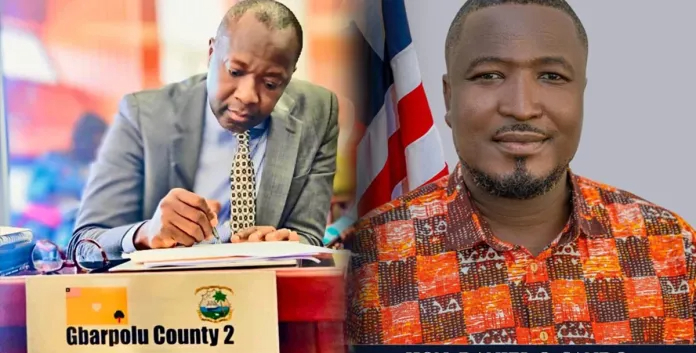
In the intricate, often volatile arena of Liberian politics, the recent verbal sparring match between Senator Amara Konneh and Deputy Minister of Information Daniel Sando serves as a sobering prism through which to view the nation’s governance crisis. What began as a high-level critique of President Joseph Boakai’s inaugural year has devolved into a cycle of personal vitriol, illuminating not just the partisan divide, but a systemic failure in the architecture of public accountability. As Liberia navigates the complexities of post-war development and economic fragility, this exchange highlights an urgent conundrum: how can a democracy mature when its political class prefers the theater of deflection over the rigor of policy discourse? Senator Amara Konneh, a former Minister of Finance and a seasoned legislative figure, launched his critique of the Boakai administration with a comprehensive assessment that painted a somber portrait of the state.
He pinpointed a perceived paralysis in leadership, citing a dearth of new foreign direct investment, the persistent specter of energy insecurity, and a distressing surge in unemployment and substance abuse among the youth. Konneh’s analysis, however, did not operate in a vacuum. By situating Liberia within the volatile currents of regional geopolitics and global economic shifts, he sought to frame the administration’s performance as inadequate to the magnitude of the challenges at hand. His rhetoric was punctuated by a poignant football analogy—suggesting that the mark of true leadership is not the absence of errors, but the integrity of the course correction.
This, for Konneh, is the benchmark by which the administration has failed. He argues for a shift away from incrementalism toward transformative, decisive governance, casting the Boakai administration as a vessel adrift without a clear, bold compass. Yet, the substance of Konneh’s economic and developmental critique was quickly obscured by the administration’s response. Deputy Minister of Information Daniel Sando, acting as the government’s mouthpiece, bypassed the structural issues raised by the Senator, opting instead for a tactical pivot toward the messenger himself.
By questioning Senator Konneh’s attendance record in the legislature and raising concerns about potential conflicts of interest, Sando utilized a classic 'tu quoque'—or 'you also'—argument. This defensive posture, while perhaps effective in the immediate theater of social media and partisan news cycles, serves as a corrosive agent in the broader national dialogue. When the government chooses to discredit a critic rather than refute a critique, it signals to the citizenry that it is more interested in the preservation of reputation than in the pursuit of administrative reform. The irony of this exchange is as palpable as it is damaging.
Konneh, who posits that leaders must be humble enough to own their mistakes, finds himself accused of the very lack of accountability he demands of others. Conversely, Sando, while highlighting legitimate questions regarding legislative duty, inadvertently reinforces the perception that the Executive Branch remains allergic to introspection. This mutual evasion of responsibility creates a vacuum of accountability, where personal score-settling supersedes the public interest. The result is a political landscape defined by circular accusations, where the pressing questions of budget efficiency, the rule of law, and institutional capacity are effectively sidelined by the noise of personality-driven conflict.
Furthermore, the incident exposes the deep-seated dysfunction within the Liberian legislature, which Konneh himself characterized as 'chaotic and benign.' That a sitting legislator would use such terminology—and that the Executive Branch would weaponize that self-assessment to undermine the Senator’s credibility—points to a profound crisis of institutional legitimacy. The legislature, intended to be the ultimate check on Executive power, is currently viewed by many as either a subservient extension of the statehouse or a battleground for individual political survival. This legislative collapse has grave implications for Liberia’s democratic trajectory, as the mechanisms of oversight are rendered ineffective when they become tools for partisan warfare.
From a media perspective, the coverage of this clash serves as a cautionary tale. In the digital age, where sensationalism drives engagement, media outlets often fall into the trap of amplifying the 'ping-pong' nature of these disputes rather than dissecting the policy failures or successes that underpin them. When the news cycle is dominated by who said what about whom, the media fails in its cardinal duty to hold power to account. The burden falls not just on the politicians, but on the institutions of the fourth estate to shift the focus back toward concrete governance outcomes—how the national budget is allocated, the transparency of contract bidding, and the tangible impact of executive decisions on the lives of ordinary citizens.
Moreover, the geopolitical context embedded in Konneh’s critique warrants deeper exploration. His mention of the shifting influence of global powers—China, Russia, and the United States—in Liberia is not merely political posturing; it is an acknowledgment of Liberia's precarious position in a multipolar world. Developing a nation in the 21st century requires a sophisticated, non-aligned foreign policy that attracts investment without compromising sovereignty. The administration’s defensive reaction to such broad-ranging critique suggests a government that may be struggling to reconcile its domestic woes with its international obligations.
A mature democracy requires an opposition that challenges with substance and a government that responds with evidence. When leaders engage in such unproductive skirmishes, they do more than just waste political capital; they deepen the cynicism of the public. If the architects of the nation’s governance cannot model the behavior of constructive, fact-based debate, one cannot expect the electorate to maintain faith in the democratic process. This is the crux of the Governance Conundrum: a misalignment between the promises of democratic institutionalism and the reality of personalized, transactional power politics.
As Liberia looks ahead to the remainder of the presidential term, the need for a shift in political culture is paramount. This requires institutional reforms that incentivize collaboration and penalize the obstructionist tendencies of all parties. It demands a legislature that asserts its independence through rigorous inquiry rather than public theater, and an executive that invites criticism as a tool for progress rather than a threat to be neutralized. The exchange between Senator Konneh and Deputy Minister Sando is a snapshot of a nation at a crossroads.
Will Liberia’s leadership continue to be mired in the unproductive cycle of 'political ping-pong,' or will they rise to meet the gravity of the systemic challenges facing the country? The potential for Liberia to emerge as a stable, prosperous democracy is significant, but that potential remains shackled to a political discourse that is currently too small for the challenges it aims to solve. The citizens of Liberia deserve more than a spectator sport; they deserve a governance model that prioritizes the collective future over the individual vanity of its current leaders. Ultimately, the resolution of this conundrum will depend on the courage of leaders to stop talking past one another and start building a common framework for accountability, transparency, and national development.
Whether or not that happens will define the success or failure of the Boakai administration and the legacy of the current legislative assembly.



