
The emergence of the moniker 'Partying President' within the Liberian socio-political discourse signifies a profound disconnect between the executive branch and the electorate. As President Joseph Nyumah Boakai traverses the complex terrain of his presidency, a recurring pattern of personal celebrations, international excursions, and perceived opulence has sparked intense scrutiny from a citizenry grappling with systemic economic instability. While the office of the President naturally requires a delicate balance between public duty and private life, the frequency and timing of President Boakai's recent engagements suggest a fundamental misalignment that threatens to undermine his administration’s mandate for 'Rescue.' To understand the gravity of this criticism, one must contextualize it within the broader history of Liberian leadership, where the performance of power has historically been synonymous with patronage and the distance between the governed and the governor.
Historically, Liberian heads of state have often been accused of prioritizing their personal social networks and symbolic milestones over the gritty, often unglamorous work of institutional reform. However, in an era of hyper-connected digital discourse and a fragile post-war economy, the tolerance for such perceived indulgences has reached an all-time low. The most vivid illustration of this tension remains the grand celebration of President Boakai’s 52nd wedding anniversary on July 29, 2024, at the Paynesville Town Hall. In a nation where civil servants often face delays in salary payments and basic social services—ranging from tertiary healthcare to public education—remain underfunded, the sight of a government leadership body engaging in an ostentatious display of wealth was viewed by many as a tactical failure in political communication.
The optics of the President and First Lady dancing at such a function, while the Ministry of Finance and Development Planning struggles to balance a debt-ridden national budget, provided a stark visual contrast to the narrative of 'fiscal responsibility' promised during the 2023 campaign. This event did not occur in a vacuum; it followed closely on the heels of the 177th Independence Day celebrations, which were marred by a diplomatic rift. When U.S.
Embassy officials exited the national orator’s presentation following remarks they deemed critical of the United States—a cornerstone donor and long-standing partner of Liberia—the political environment was already fraught with anxiety. To proceed with a grand personal celebration in the immediate aftermath of this diplomatic friction was perceived by many analysts as a demonstration of profound tone-deafness, signaling a retreat into personal comfort at the expense of necessary diplomatic damage control. The regional implications of the President’s travel schedule have also come under fire, most notably his trip to Accra, Ghana, on December 27, 2024. Attending the wedding of the daughter of a personal friend, Samuel P.
Oduro, while technically framed as a dual-purpose visit involving meetings with Ghanaian officials, raised fundamental questions about the transparency of state resources. In the context of the Economic Community of West African States (ECOWAS), Liberian presidents are expected to lead through example. When the line between private friendship and state business blurs, it creates an opening for critics to argue that the executive office is being utilized for private social capital accumulation. This was preceded by the extended visit to the United States in July 2023 for his granddaughter’s wedding, a trip that spanned multiple states and occupied significant time during the heat of a pivotal election cycle.
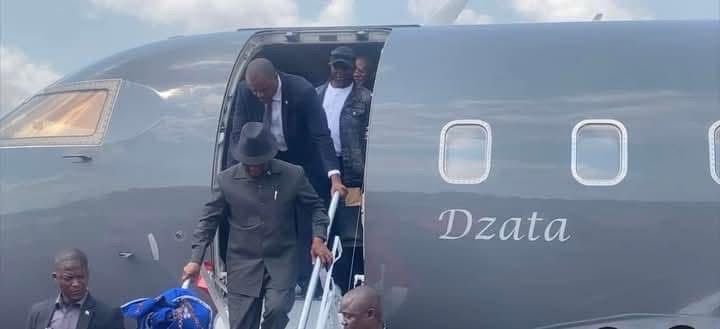
While familial obligations are undoubtedly humanizing, the length of such international sojourns during critical domestic junctures creates a narrative vacuum, often filled by the perception that the President is 'absentee' or detached from the lived realities of the 'common Liberian.' The discourse surrounding the use of private jets serves as perhaps the most significant point of ideological hypocrisy. During his years as an opposition leader, Boakai was a vocal critic of the excesses associated with the presidency, including the use of private, often donor-provided transport, which he frequently characterized as a tool of corruption or influence-peddling. Consequently, when he utilized a private jet (tail number CN-SYA) for a one-day working visit to Guinea Bissau in May 2024, the irony was not lost on the electorate.
Despite his administration's defense—claiming these jets are provided by 'friends' and thus do not burden the national treasury—the public remains skeptical. In the Liberian political context, the concept of 'friends of the President' often masks complex webs of influence, where private individuals providing luxuries to the Head of State expect, or at least gain, a proximity to power that can be leveraged for private gain. This creates a reputational risk that the administration has yet to effectively mitigate. Furthermore, the 80th birthday celebration held at the Ellen Johnson Sirleaf Ministerial Complex on November 30, 2024, highlighted a preoccupation with personal milestones that many argue should be secondary to the Herculean task of national development.
While the President’s foundation work is a legitimate pursuit, the choice of the Ministerial Complex—the heart of government operations—as the venue for an essentially personal milestone underscored the ambiguity between the individual and the institution. The cumulative effect of these events is a 'Partying President' narrative that has solidified in the public imagination, amplified by social media platforms that allow for instantaneous, unfiltered commentary. This sentiment is not merely a matter of bad optics; it is a manifestation of deeper frustration regarding the slow pace of change. An analysis of President Boakai’s first 100 days revealed that only 10% of his campaign commitments had been visibly met, creating a performance gap.
When expectations are high and delivery is low, symbols of excess are magnified, turning otherwise mundane personal events into lightning rods for political discontent. The economic reality in Liberia—marked by high inflation, currency volatility, and an unemployment crisis—demands a leadership style characterized by austerity, discipline, and a visible commitment to the struggle of the masses. By failing to modulate his personal engagements to reflect this state of emergency, President Boakai risks squandering the political capital he worked decades to build. The challenges of leading Liberia are vast; the country requires a President who is seen as a 'Partner in Struggle' rather than a 'Leader of Leisure.'
The 'Partying President' label is not necessarily a reflection of malice, but it is a reflection of a perceived lack of emotional intelligence regarding the plight of the average Liberian. As the administration moves forward, the pressure to pivot toward more austere, transparent, and focused governance will only intensify. The legacy of the Boakai presidency will likely be determined not by the milestones he celebrates privately, but by his ability to reconcile the opulent habits of the past with the humble, urgent needs of the future. The public's patience is not infinite, and in the current climate of democratic fatigue, the administration must ensure that every public action serves the collective national interest, lest the 'Partying President' label becomes the permanent epitaph of his political career.



