
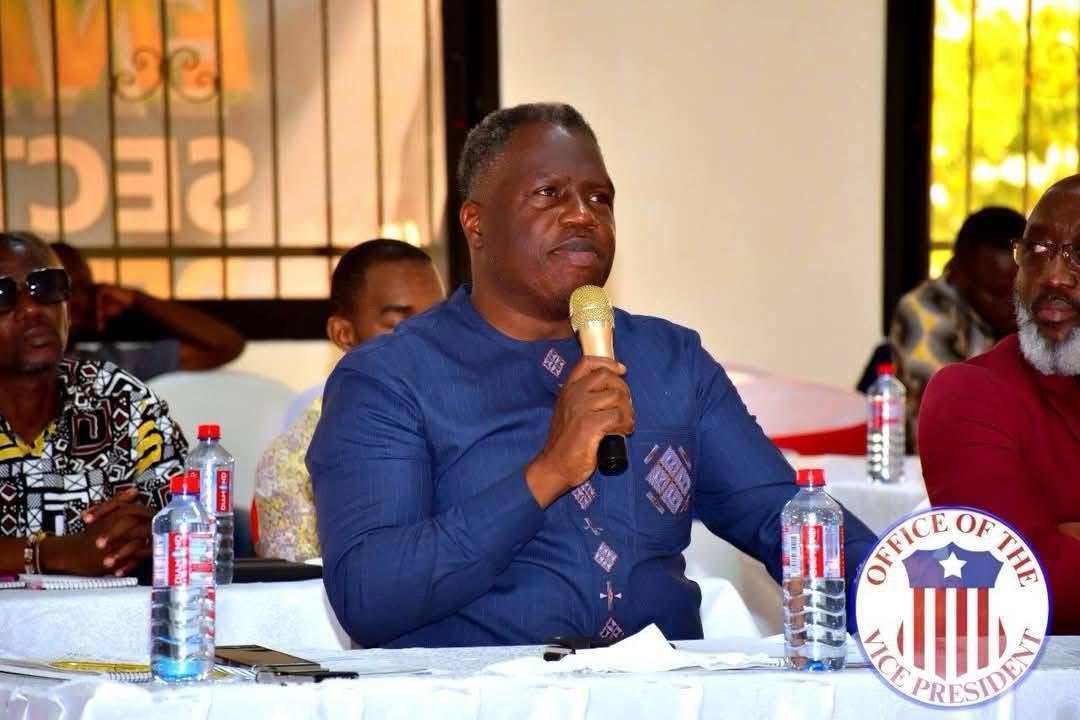
In the complex theater of Liberian politics, optics are often as significant as policy, and few recent pronouncements have resonated as discordantly as Vice President Jeremiah Koung’s self-assessment during a recent engagement with the Union of Liberian Associations in the Americas (ULAA) in Pennsylvania. By describing himself as a 'parked car'—a metaphor intended to illustrate the perceived lack of constitutional mandate or defined administrative role assigned to his office—Koung unintentionally ignited a firestorm of public indignation. In a nation where the citizenry is increasingly disillusioned by the chasm between the political elite and the marginalized populace, the imagery of a vehicle that is stationary yet consuming high-octane fuel at the taxpayer’s expense has become a powerful, if incendiary, symbol of governance failure. The 'parked car' analogy, while perhaps meant to be a candid admission of the limitations of the vice presidency in the Liberian political structure, backfired spectacularly.
It transformed an abstract critique of executive branch friction into a tangible scandal regarding fiscal waste, forcing a conversation about why a 'stationary' office continues to command millions of dollars in budgetary allocations while the nation’s essential services languish in chronic disrepair. To understand the gravity of the public outcry, one must examine the raw data of the budgetary allocations. For the fiscal years 2024 and 2025, the office of the Vice President was apportioned $3.76 million and $3.
9 million respectively, culminating in a staggering two-year total of $7.66 million. This figure is not merely a line item; it is a profound policy statement. When viewed alongside the fact that these allocations have, at various intervals, surpassed the operational budget of the President’s own office, the situation invites scrutiny into the lack of fiscal discipline that characterizes current executive branch spending.
The presence of $259,000 for foreign travel and $48,000 for entertainment within these documents serves as a bitter pill for a population struggling with the realities of 34.2% poverty rates and crumbling infrastructure. The disparity is not just economic; it is moral. When schools lack textbooks and public hospitals are defined by a chronic absence of basic diagnostics and medication, the allocation of luxury budgets to an office that claims to be 'parked' suggests a profound disconnect between the ruling class and the reality of the post-conflict Liberian state.
Historically, the Vice Presidency in Liberia has been a precarious office. The 1986 Constitution provides few specific administrative duties beyond those delegated by the President, often leaving holders of the office to find their own relevance. However, previous occupants have sought to engage in oversight or developmental diplomacy. Koung’s framing of his role as passive is not just a personal admission; it is an indictment of the current administration’s failure to delegate authority effectively, or perhaps, a sign of political isolation.
From an economic perspective, the timing of these complaints could not be more critical. The International Monetary Fund and World Bank have recently noted that while Liberia’s GDP growth is projected to reach 5.2% in 2024 and 6.2% in 2025—driven largely by the extractive mining sector and service expansions—this growth is precarious.
It remains highly susceptible to global commodity price fluctuations and lacks the structural integration necessary to uplift the rural poor. With a fiscal deficit forecasted to widen between 4.2% and 4.5% of GDP, the government’s insistence on maintaining opulent budgets for the offices of the presidency and vice-presidency appears detached from the austerity required by the macroeconomic climate.
The fiscal deficit is not just a number; it represents the state’s inability to fund critical development projects, leading to increased borrowing and long-term debt servicing burdens that will constrain future generations. The outrage expressed by civil society organizations and economic analysts is not merely a partisan reaction; it is a symptom of a systemic governance deficit. Liberians are tired of the 'business as usual' approach where the spoils of political victory are prioritized over the developmental mandate. The 'parked car' metaphor has served as a catalyst for a broader dialogue on the need for the 'ARREST' agenda—the current administration’s inclusive development framework—to move from rhetoric to reality.
If the administration claims to prioritize agriculture, road connectivity, and education, the budgetary allocations must reflect these priorities with surgical precision. Instead, the current reality demonstrates that the state apparatus is still too focused on sustaining the bureaucracy of the executive rather than investing in the human capital of the nation. For the Vice President to suggest that his office is a 'parked car' is to admit that there is no functional output justifying the massive input. In any private sector enterprise, a department with a budget of nearly $4 million that admits to producing nothing would be liquidated immediately.
While the constitutional protections for the Vice Presidency prevent such swift action, the political consequences are manifest. The erosion of public trust is a slow, corrosive process, but the 'parked car' scandal has accelerated it. The Liberian public is demanding accountability. They are asking why the executive is not auditing its own internal spending before asking the populace to bear the brunt of inflation and economic stagnation.
The path forward requires a radical overhaul of budgetary transparency. It is not enough for the government to publish figures; it must defend the necessity of every dollar spent. It is time for the legislative branch, which holds the power of the purse, to engage in rigorous oversight of these allocations, stripping away the 'entertainment' and 'foreign travel' excesses that define the current administrative bloat. The broader regional significance of this issue cannot be overlooked.
In a West African landscape where democratic backsliding is a recurring concern, the performance of Liberia’s institutions is closely watched. Transparency and fiscal prudence are not just domestic requirements; they are the bedrock of regional stability. When high-level officials speak flippantly about their lack of function while drawing millions, it sends a dangerous signal that state resources are mere tools for patronage rather than instruments for public good. This is a moment of reckoning for the Liberian leadership.
They must decide if they are willing to shift the gears of governance, put the 'parked car' to work for the people, or continue down a path that leads only to deeper disillusionment and public protest. Restoring trust requires more than apologies; it requires a systematic realignment of the national budget to mirror the national struggle. Until the government proves that the resources of the state are being channeled into the hospitals, the classrooms, and the agricultural cooperatives, the 'parked car' will remain a stinging symbol of a nation left idling on the roadside of progress, burning fuel while going nowhere.
