
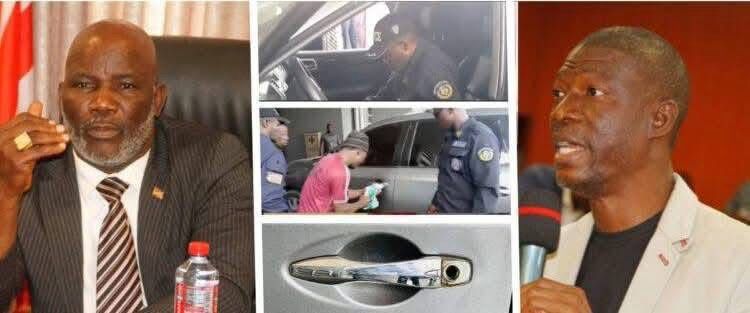
The Liberia National Police (LNP) recently announced the suspension of two officers involved in the now-infamous Capitol Hill vehicle vandalism incident, an act that has sent shockwaves through the corridors of power in Monrovia. However, for observers of the Liberian political landscape, this move feels less like a genuine commitment to the rule of law and more like a superficial, desperate attempt to mitigate public outrage following Speaker Richard Koon’s alleged power-fueled escapade. The incident, which was caught on camera, has become a potent symbol of the deeper malaise affecting our governance: the normalization of impunity among the political elite. When a high-ranking official like the Speaker of the House of Representatives can allegedly authorize the destruction of a fellow lawmaker’s property, the democratic foundation of the Republic is inevitably compromised.
The video evidence is stark and damning. Speaker Koon, reportedly incensed that Representative Yekeh Kolubah had parked in what he considered his 'reserved' parking spot, allegedly ordered state security personnel to use a drill to breach the vehicle. The phrase 'Bring the Drill!' has quickly permeated the Liberian lexicon as a rallying cry for those critical of the government's increasing tendency toward heavy-handed tactics.
This incident is not merely about a parking dispute; it is about the weaponization of the state apparatus for personal grievances. Beyond the blatant act of property destruction, Representative Kolubah has leveled grave allegations of theft, claiming that US$25,000 and L$2 million were missing from the vehicle following the forced entry. While the LNP maintains that they are conducting an investigation, the public remains understandably skeptical. Given that Speaker Koon’s fingerprints are symbolically all over the scene, the question remains: can any internal inquiry, managed by a police force that answers ultimately to the executive, remain truly impartial?
The history of the LNP is marred by accusations of political bias and professional misconduct. According to recent Afrobarometer reports, a significant portion of the Liberian population continues to express deep distrust in the national police, citing corruption and a lack of professionalism as primary failings. This deep-seated skepticism is not born of a vacuum. It is the result of decades of systemic issues within the security sector, which has struggled to transition from a force tasked with protecting the regime to one tasked with serving the people.
The incident involving Speaker Koon is merely the latest chapter in a long history of institutional failures. Reports suggest that this is not an isolated event but rather part of a troubling pattern associated with Speaker Koon’s tenure, including previous allegations of unauthorized office entries and other acts that disregard the sanctity of legislative spaces. This behavior reflects a broader disregard for the rule of law, suggesting that for certain officials, the constitution and the standing orders of the legislature are merely suggestions rather than binding mandates. The question of whether Koon is 'untouchable' is becoming a central theme in the current legislative session.
In a democracy, no individual, regardless of their position in the hierarchy, should operate above the law. When the Speaker, the leader of the body responsible for making the laws of the land, is seen openly flouting them, it sets a dangerous precedent for the entire country. The silence or tepid response from other sectors of government only serves to reinforce the perception that the political class remains an insular, protected fraternity. We must also consider the role of the LNP in this saga.
The police force has historically been caught between its duties to uphold the law and the political pressures exerted by those in power. When officers are used as pawns in the personal spats of politicians, the entire institution loses its legitimacy. By suspending two officers, the LNP may be attempting to offer a sacrificial lamb to appease the public, but this does not address the systemic issue of political subordination. The structure of the LNP, which lacks sufficient independence, makes it incredibly difficult for officers to refuse unlawful orders, especially when they come from high-ranking officials who control their budgets, promotions, and job security.
The implications of this incident extend far beyond the Capitol Building. Liberia, a country that has endured civil conflict and the long, arduous process of reconstruction, relies heavily on the strength of its democratic institutions to maintain stability. When those institutions are undermined by the very people elected to lead them, public trust evaporates. Democracy is sustained by the belief that there is a level playing field.
If one member of the legislature can have their car vandalized with impunity because they challenged the Speaker, what hope does the ordinary citizen have when they find themselves on the wrong side of a powerful official? Representative Kolubah, while a controversial and often polarizing figure in his own right, is an elected representative of the people. Regardless of one’s political leanings toward him, the sanctity of his office and his rights as a citizen must be upheld. To treat the vandalism of his property as a minor infraction is to diminish the office of the representative itself.
The international community, including bodies like the United Nations and various human rights organizations, has long pushed for police reform and the strengthening of accountability mechanisms in Liberia. Reports from Human Rights Watch and other observers have repeatedly highlighted how corruption and abuse of power within the police force contribute to a lack of justice for the vulnerable. The incident with Speaker Koon serves as a textbook example of these warnings being ignored. If this situation is allowed to be swept under the carpet, it will only embolden those who believe that political power grants them a license to operate outside the law.
As Liberia navigates the complexities of its young democracy, the need for a non-partisan, professional, and accountable police force has never been more urgent. We must demand a full, transparent, and independent investigation into the claims made by Representative Kolubah. This includes not only the vandalism of the vehicle but also the alleged theft of the substantial sums of money reported. Furthermore, there must be a clear conversation about the behavior expected of those in high office.
The Speaker of the House is a representative of the entire nation and should exemplify the highest standards of integrity and respect for the rule of law. A failure to hold Speaker Koon accountable, if the allegations are proven, will constitute a major blow to Liberia’s democratic credentials. It sends a message to the international donor community, to investors, and most importantly, to the Liberian people, that the 'old ways' of patronage and impunity are still very much alive. The path forward requires a firm commitment to institutional independence.
This means shielding the LNP from political interference, ensuring that the judiciary is capable of adjudicating cases involving high-ranking officials without fear or favor, and fostering a culture of accountability where leaders are held to the same standards as the citizens they serve. The incident on Capitol Hill is a wake-up call. It is not just about a car, a parking spot, or a drill. It is about the soul of our democracy and whether we are prepared to defend the principles that were supposed to guide us after the end of our civil war.
If we are to honor the sacrifices made to build this peace, we must ensure that justice is not just a concept, but a lived reality for every Liberian, from the streets of Monrovia to the seats of power in the Capitol Building. Will Koon face justice? That remains the million-dollar question, one that will determine if Liberia is truly moving forward or merely repeating the mistakes of the past. The citizens are watching, and the history books are being written with every decision made in these critical times.
