
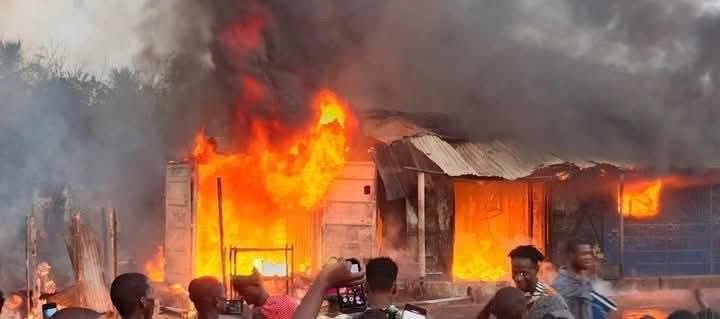
Lofa in Chaos: Death in Custody Ignites Civil Unrest. The smoke rising from the charred remains of the Zogolemai Magisterial Court in Lofa County is not merely the result of a singular act of arson; it is a visible manifestation of a smoldering, systemic crisis that has long permeated the Liberian justice sector. When the life of 19-year-old Yakpawolo Moisemai was extinguished under the watch of the Liberia National Police, it did more than end a young life; it effectively ruptured the fragile social contract between the state and the people of Lofa. This tragedy serves as a harrowing case study in how deep-seated public mistrust, combined with institutional incompetence and a lack of transparency, can transform a local grievance into a volatile, county-wide security threat.
The death of Moisemai, who was held as a witness in a sensitive murder investigation, has unearthed the ghosts of Liberia’s painful history, reminding us that when the mechanisms of justice fail, the citizenry often resorts to extralegal measures, not out of inherent malice, but out of a desperate belief that the law has become an instrument of oppression rather than protection. The official narrative provided by the authorities—that the young man committed suicide by hanging himself with his shirt while in police custody at the Voinjama Police Barracks—has been met with profound skepticism that borders on outright rejection by the local population. In the eyes of the community, this explanation is not merely suspicious; it is an affront to their intelligence. The timing is particularly damning.
Moisemai was a crucial witness, a person whose testimony held the potential to unravel a complex murder case. To have such a witness perish in the very facility designed to ensure his safety and secure his testimony reeks of the kind of institutional interference that has historically plagued Liberian law enforcement. Throughout the post-conflict era, the Liberia National Police has struggled to shed the reputation of being a tool for the powerful, often viewed as a force that operates on patronage and political directives rather than professional standard operating procedures. When a death occurs in custody under such circumstances, the vacuum left by the lack of clear evidence is rapidly filled by a pervasive sense of conspiracy.
The burning of the court in John's Town and the subsequent assault on state facilities are not simply acts of criminal vandalism; they are symbolic declarations of an 'anti-system' sentiment that is taking root in rural Liberia. These actions reflect a society that has reached a breaking point, where the traditional avenues for seeking redress—the courts and the police—are viewed as fundamentally broken or compromised. Historically, Lofa County has maintained a distinct identity, often finding itself at the periphery of the centralized power dynamics in Monrovia. This geographic and political distance has frequently resulted in a feeling of neglect, where the state only appears in the form of tax collectors, checkpoints, or, as in this case, a heavy-handed and untrustworthy security apparatus.
The frustration boiling over in Lofa today echoes sentiments seen in other parts of the country, where communities have felt ignored until violence becomes the only language the government seems willing to understand. The destruction of the John's Town checkpoint, which forced a total withdrawal of police personnel, is perhaps the most alarming aspect of the unrest. For a state to lose the ability to maintain a physical presence in a territory is to lose the fundamental hallmark of sovereignty. If the government cannot protect its institutions—or its witnesses—from internal decay or external destruction, the resulting security vacuum invites criminal opportunism and creates a permissive environment for further instability.
The broader implications for Liberia’s national security are significant. We have witnessed a recurring pattern of deaths in custody and mysterious passing of high-profile figures in recent years, including the tragic cases of auditors and officials whose deaths were shrouded in administrative silence and unconvincing police reports. These recurring events create a 'normalization' of suspicion. When the public assumes that the police are either complicit or grossly negligent in every suspicious death, the entire edifice of the rule of law begins to crumble.
The international community, which has invested millions into police reform and judicial strengthening in Liberia, must also acknowledge the limitations of these efforts if they are not paired with a genuine political will to ensure accountability at the highest levels. Reforms that focus solely on training and equipment often fail when the institutional culture remains one of secrecy and impunity. Without an independent, transparent, and rigorous investigation into the death of Yakpawolo Moisemai—one that includes the participation of respected civil society actors and, perhaps, international observers—the wound will continue to fester. A mere departmental inquiry, which often serves only to protect the reputation of the force, will be insufficient to restore public trust.
Justice for Moisemai must involve more than just a closed-door report; it requires a public accountability process that addresses the failures of the Voinjama Police Barracks and holds those responsible for his security to account. Furthermore, this crisis demands a serious, honest appraisal of the current state of regional policing. The decentralization of the security sector remains a work in progress, and the lack of oversight mechanisms at the county level often allows local commanders to operate with minimal supervision from the Inspector General’s office. This lack of oversight is a catalyst for the kinds of abuses that lead to public rage.
If the government continues to ignore the warning signs—be it in the mining sector with protests at Bea Mountain or in the heart of Lofa—the cumulative effect will be a nation characterized by recurring localized insurgencies against state authority. The path forward is undoubtedly steep. The government of Liberia must shift from a posture of denial to one of radical transparency. This means releasing the preliminary findings of an independent audit into the holding cell conditions, inviting a forensic investigation that is not controlled by the local police, and ensuring that any officer found to have acted with negligence or criminal intent faces the full weight of the law, regardless of their rank or political connections.
The restoration of the burned court and the damaged police facilities is an architectural necessity, but the restoration of the public’s faith in those institutions is a monumental moral imperative. Unless the administration demonstrates a commitment to justice that transcends partisan interests, the chaos in Lofa will likely serve as a blueprint for future unrest. The people of Lofa are not asking for much; they are asking for the baseline of a functional state: the truth, accountability, and the belief that the law applies to everyone equally. Until that is provided, the cycle of distrust will remain the primary driver of political and social life in the region.
As we look ahead, the challenge for Liberian leadership is to bridge the widening gap between the governors and the governed. The crisis in Lofa is not an isolated fire to be put out; it is a signal that the embers of the past—of unresolved grievances and institutional decay—are still very much alive and capable of setting the entire country ablaze if left ignored.
