
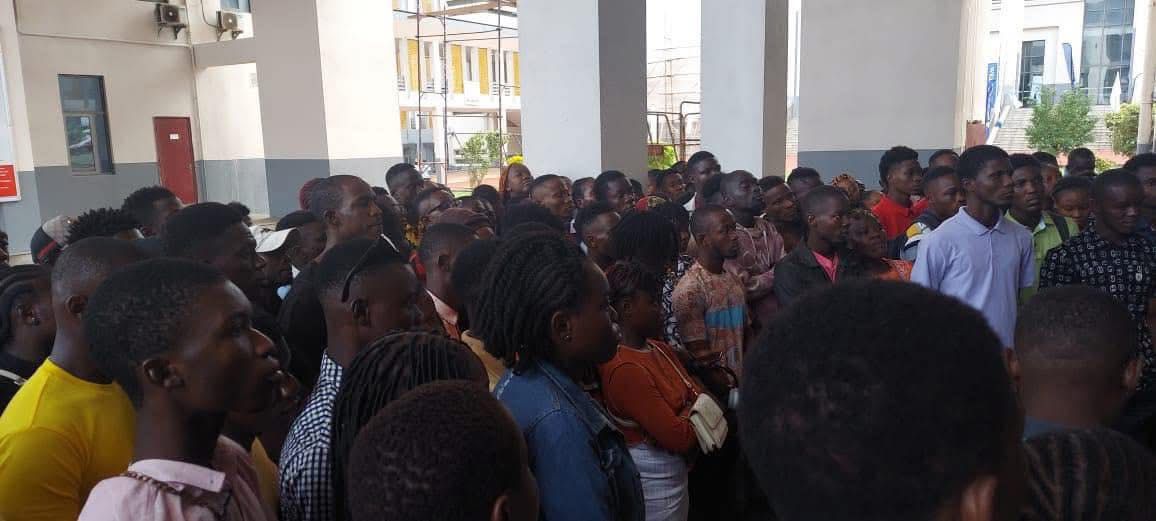
The scenes unfolding outside the Ministry of Labor in Congo Town are far more than a routine bureaucratic exercise; they are a visual manifestation of a ticking socio-economic time bomb. For the past several days, hundreds of young Liberians have braved the elements, arriving before the first light of dawn. They clutch worn folders, sweating under the encroaching sun, fueled by the desperate hope of securing one of the 1,000 placements offered through the government’s annual Vacation Job Scheme. These young men and women, many of whom are high school or college students, represent a demographic that constitutes the majority of Liberia’s population, yet finds itself systematically excluded from the formal economy.
This is not merely a logistical failure of public administration; it is the frontline of a national emergency that threatens to undermine the fragile stability of the post-conflict state. To understand why thousands of youths would clamor for a temporary position, often lasting only a few weeks, one must confront the grim reality of the Liberian labor market. According to data from the International Labour Organization (ILO), over 80% of Liberia’s youth are trapped in the informal sector. In this precarious landscape, employment is rarely defined by contracts, benefits, or long-term security.
Instead, it is characterized by day-to-day survival—selling goods in congested markets, navigating the treacherous world of informal transport, or performing manual labor for meager, irregular earnings. This sector offers no path for professional advancement, no pension, and no safety net. When the World Bank cites an official unemployment rate hovering around 4%, it masks a much more sinister reality. This figure, often touted in political discourse, relies on narrow definitions that exclude the vast numbers of people who have simply given up on finding work or are stuck in the 'underemployment' trap, working hours that yield wages insufficient to lift a household out of poverty.
The African Development Bank paints a more accurate, albeit sobering, picture, suggesting that over one-third of Liberia’s youth fall into the category of NEET—Not in Education, Employment, or Training. This generation is effectively drifting, disconnected from the institutions that could foster their development and provide them with a stake in the nation’s future. The historical context of this crisis is deeply rooted in Liberia’s recovery from fourteen years of civil war, a conflict that decimated infrastructure, stunted education systems, and fractured the social contract. For years, the international community and domestic policymakers have focused on macroeconomic stability—managing debt, attracting foreign direct investment in extractive industries like mining and palm oil, and stabilizing the currency.
However, these top-down economic strategies have largely failed to translate into tangible opportunities for the average young Liberian. The extractive industries, while significant for GDP, remain capital-intensive rather than labor-intensive. They provide few jobs for a youth population that lacks the specialized technical training required to operate in high-tech or industrial settings. Consequently, a massive skills gap exists, exacerbated by an educational system that is still struggling to align its curriculum with the demands of a modernizing economy.
The social implications of this systemic failure are profound and immediate. When an entire generation is denied the dignity of work, the result is an erosion of the social fabric. We see the symptoms in the rising rates of petty crime, the increased prevalence of substance abuse in urban slums, and the susceptibility of desperate young people to political manipulation. During election cycles, unemployed youth are frequently recruited as 'foot soldiers' for political factions, turning legitimate grievances into fodder for partisan volatility.
This is a dangerous cycle; when the state fails to provide a future, it loses its moral authority to command the loyalty of its citizens. Furthermore, the regional significance of this issue cannot be overstated. Liberia is part of a West African demographic shift where youth bulges are common, but the failure to harness this 'demographic dividend' risks creating long-term regional instability. As neighboring states grapple with similar issues, the movement of disillusioned youth across borders in search of better prospects often leads to broader security challenges.
The government’s Vacation Job Scheme, while well-intentioned as a short-term intervention, is ultimately a band-aid on a gaping wound. It provides temporary relief for 1,000 individuals, but what of the tens of thousands who are turned away, or those who age out of this scheme and find that the labor market has not expanded to receive them? A true solution requires a radical shift in economic policy. It demands a pivot toward labor-intensive sectors, such as mechanized agriculture, small and medium enterprise (SME) development, and localized manufacturing—sectors that can absorb the youth labor force and provide a ladder to stability.
It requires a complete overhaul of vocational training, moving away from theoretical education toward competency-based learning that matches the needs of local entrepreneurs. The political will to move from short-term patronage to long-term structural reform has been historically absent. Policymakers often prefer initiatives that offer high visibility, such as the vacation jobs program, because they serve as convenient instruments of political optics. However, true leadership requires the courage to invest in the grueling, long-term work of creating an enabling environment for private sector growth and building a robust technical education pipeline.
The scenes at the Ministry of Labor are a warning. They are a mirror held up to the face of the nation, reflecting a youth population that is resilient and hardworking, but profoundly let down by the state. As long as the economy remains exclusionary, the aspirations of these young people will continue to be stifled, and the potential for national development will remain trapped in the waiting room of history. If the government continues to treat this issue as a seasonal logistical hurdle rather than the existential threat that it is, the frustration of the masses will inevitably find a more disruptive outlet.
The time for empty rhetoric and temporary fixes has long passed. Liberia needs a comprehensive, youth-centered economic strategy that addresses the core drivers of unemployment, from infrastructure and energy deficits to the lack of access to credit for young entrepreneurs. Anything less is a betrayal of the next generation and a gamble with the future stability of the republic.
