
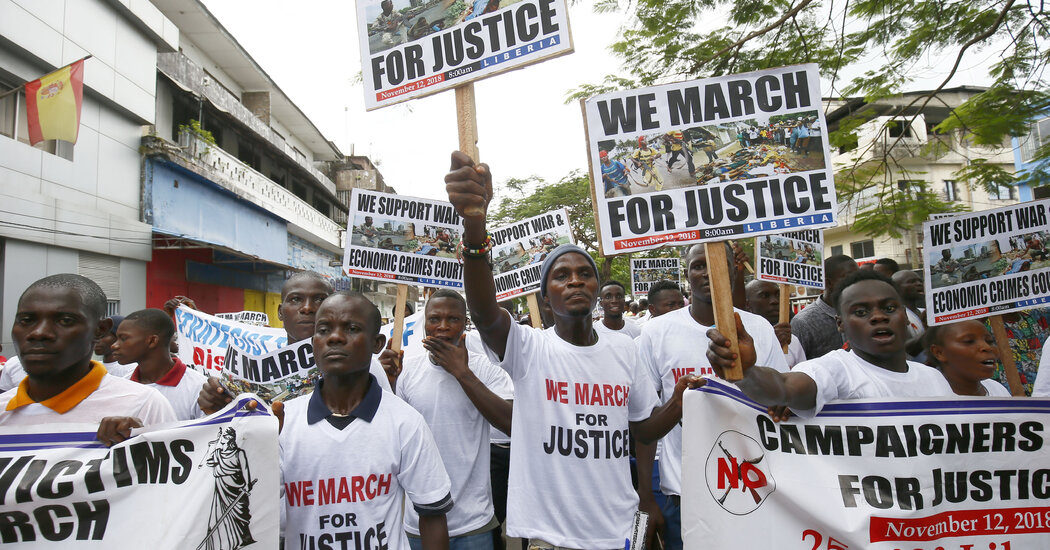
The establishment of a War and Economic Crimes Court (WECC) in Liberia represents the most ambitious attempt to confront the specter of the country's brutal civil wars, a period of carnage that left an estimated 250,000 dead and a social fabric permanently frayed. After decades of vacillation, systemic impunity, and failed political promises, the creation of this tribunal was hailed as a watershed moment for justice. However, the optimism surrounding this initiative has been rapidly eclipsed by a burgeoning leadership crisis. President Joseph Boakai’s decision to replace his initial appointee, Jonathan Massaquoi, with Jallah Barbu as the head of the Office of the War and Economic Crimes Court (OWECC), has ignited a firestorm of controversy.
This leadership pivot has not merely fueled gossip in the corridors of Monrovia’s political elite; it has raised fundamental questions about the government's commitment to judicial independence and the potential for political weaponization of the transitionary justice process. The sudden nature of the transition, coupled with the opacity surrounding the rationale for the change, has placed the credibility of the entire endeavor at risk before the first witness is even called. The stakes for Liberia are existential: justice is not merely an act of retribution, but a prerequisite for long-term stability and national healing. When the integrity of the institution tasked with delivering this justice is compromised by perceived political maneuvering, the ghosts of the past become more difficult to exorcise.
The lack of transparency surrounding Boakai’s decision-making process is the central grievance among critics. In a nation where the public has been hardened by years of systemic corruption, the failure of the Executive Mansion to issue a detailed, evidence-based justification for Massaquoi’s removal has created a vacuum, quickly filled by suspicion and distrust. This is not merely an administrative reshuffle; it is a signal of the political environment in which the tribunal will operate. When an appointment process is shrouded in mystery, it inevitably suggests that the criteria for leadership are dictated by political loyalty rather than legal acumen, impartiality, or the specialized experience required to handle complex international humanitarian law.
This, in turn, risks alienating the victim communities whose advocacy made the court possible. These groups view the WECC as their final avenue for redress, and for them, the court is not a political tool but a moral necessity. The optics of the replacement suggest to many that the government is testing the waters of control, potentially positioning the tribunal to serve as a filter for justice rather than a conduit for it. The debate over the suitability of Jallah Barbu, while acknowledging his significant stature as a former Dean of the Louis Arthur Grimes School of Law, is indicative of a deeper skepticism regarding the selection process.
While Barbu’s legal credentials are unimpeachable in an academic sense, the transition has reignited the scrutiny on why the initial vetting of Massaquoi failed to address concerns earlier, or conversely, why those concerns were suddenly deemed fatal to his tenure. The fact that the Coalition for Justice in Liberia and other advocacy groups had previously flagged concerns regarding Massaquoi’s past legal work—specifically his representation of individuals accused of war crimes—only adds to the confusion. If the government’s initial vetting process was flawed, it suggests a lack of institutional rigor in setting up such a high-stakes court. If the replacement was a knee-jerk reaction to political pressure, it undermines the very idea of an independent judiciary.
Either way, the message delivered to the international community and the Liberian citizenry is one of instability. A tribunal tasked with the magnitude of post-war accountability must be a bastion of continuity. Constant shifts in leadership, especially under the cloud of executive fiat, signal to potential witnesses and international donors that the tribunal may be susceptible to the political whims of the sitting administration. This volatility is the primary enemy of justice.
Potential witnesses, many of whom have lived in fear of retaliation for over twenty years, require ironclad assurances that the institution they are engaging with is permanent, insulated from political interference, and driven solely by the rule of law. When they observe that the leadership of that institution can be swapped without notice, their willingness to provide testimony—the lifeblood of any war crimes court—necessarily diminishes. Furthermore, the political polarization caused by this leadership change cannot be ignored. Liberia’s political landscape is notoriously fragile.
The civil wars were fought along ethnic and factional lines that remain visible in the current political discourse. If the WECC is perceived to be operating in a manner that protects certain political figures while pursuing others, the court will inevitably be viewed as a partisan weapon. This risks deepening existing divisions and potentially triggering renewed social tensions. The history of international justice provides clear cautionary tales.
The Special Court for Sierra Leone, while ultimately successful in prosecuting figures like Charles Taylor, benefited from a high degree of international independence and a clear, unwavering mandate. Similarly, the challenges faced by the International Criminal Court in maintaining legitimacy in African states underscore the necessity for transparent, inclusive, and neutral appointment processes. Liberia, in its attempt to forge its own path, appears to be grappling with the classic dilemma of post-conflict societies: the tension between political control and judicial autonomy. The lesson from history is clear: whenever a government attempts to manage a war crimes tribunal for political convenience, the result is almost always a failure of legitimacy.
The road map for restoring confidence in the WECC is as demanding as it is necessary. First, the administration must move beyond the current opacity. It is incumbent upon the government to conduct an audit of the current appointment procedures and release a comprehensive report explaining not only the reasons for the leadership change but also the strategic plan for the court’s future. Transparency is not just a diplomatic courtesy; it is a mechanism for building public buy-in.
Second, the government should consider empowering an independent oversight committee, comprised of civil society leaders, international legal experts, and representatives of victim associations, to audit the tribunal's administrative and appointment processes. By delegating the vetting and oversight of the court's leadership to an independent body, the government could significantly insulate the tribunal from the perception of political interference. This would serve to legitimize the court in the eyes of a skeptical public and reassure the international partners who remain the primary financiers of the judicial process. Third, the legislative branch must take a more proactive role in codifying the independence of the WECC.
The court should be established through an act of law that explicitly protects the tenure of its commissioners and limits the president's power to dismiss them, save for cases of proven malfeasance or incompetence determined by an independent tribunal. Without such legal safeguards, the WECC will remain a tenant in the house of the executive, subject to eviction at any time. Finally, the government must engage in a sustained and honest dialogue with the victims of the civil wars. The tribunal is not a remote bureaucratic office; it is a response to the pain and suffering of the Liberian people.
By acknowledging the anxieties caused by the recent leadership change and addressing them directly, the administration could demonstrate that it is a partner, rather than a gatekeeper, in the pursuit of justice. The months ahead will be critical. The international community, including donors and human rights watchdogs, will be observing the operational launch of the WECC with heightened scrutiny. If the government fails to stabilize the leadership and clarify its adherence to the principles of impartial justice, it risks transforming a historic opportunity for reconciliation into a missed chance that could haunt the country for another generation.
Justice is a fragile commodity in post-conflict states; once squandered, it is rarely recovered. The leadership of the WECC must prove, through actions rather than rhetoric, that it serves the cause of truth and accountability, and that it is fully shielded from the reach of those who would see it silenced or sidelined. Only then can the court begin the arduous work of healing the deep, festering wounds of Liberia’s past.
