
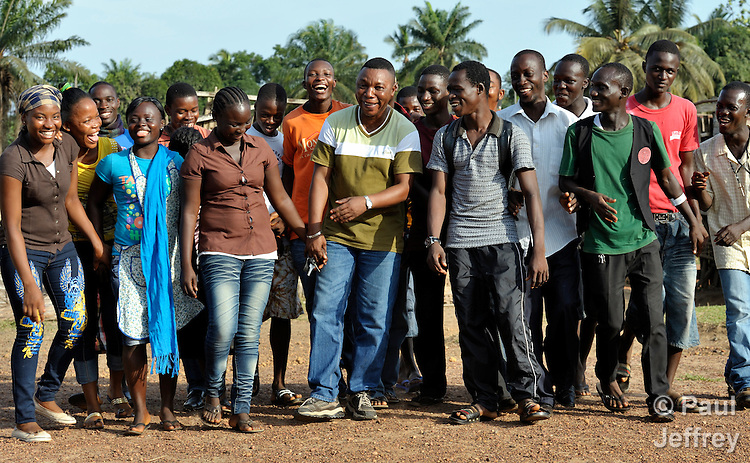
Liberia stands at a pivotal demographic crossroads, defined by a reality that is as striking as it is consequential: according to 2022 World Bank data, approximately two-thirds of the nation’s population is under the age of 25. This statistic is more than a demographic marker; it is the heartbeat of the Liberian narrative, representing a profound 'youth bulge' that acts as both an engine for potential revitalization and a ticking clock for social stability. As the nation moves further away from the shadows of its civil conflict, which devastated infrastructure and social cohesion, the generation born into a post-war reality faces a unique set of circumstances that will determine the trajectory of Liberia’s future for decades to come. This demographic weight is not merely a numerical fact; it is a structural reality that demands an immediate, rigorous, and multi-dimensional strategic response from government, the private sector, and civil society.
Historically, Liberia’s development has been hampered by cycles of political volatility and institutional weaknesses. Following the conclusion of the civil war in 2003, the focus shifted toward rebuilding the state, yet the sheer speed of population growth has often outpaced the expansion of essential services and economic opportunity. This imbalance is felt most acutely by the youth, who find themselves navigating a labor market that is largely stagnant, formalizing slowly, and struggling to move beyond a reliance on extractive industries. The opportunity inherent in this demographic profile lies in the energy and adaptability of the youth.
Young Liberians are, by necessity, entrepreneurial. Across the streets of Monrovia, from the bustling markets of Red Light to the burgeoning tech scenes in urban hubs, one sees a pervasive spirit of survival and innovation. Young people are demonstrably more adaptable to the digital revolution, more prone to challenging antiquated power structures, and more willing to experiment with new economic models. In an increasingly globalized world, this demographic dividend could, if properly cultivated, position Liberia to leapfrog older, more rigid economic models.
Young minds are inherently more creative, more capable of 'thinking outside the box' to solve the country's persistent infrastructural and agricultural challenges. However, the conversion of this potential into economic growth is not an automatic process. It requires a stable foundation of education, capital, and mentorship—resources that remain significantly underdeveloped in the current Liberian context. The challenges posed by this demographic reality are stark and, if left unaddressed, carry the risk of systemic social unrest.
When a large, vibrant, and capable population finds its path forward blocked by institutional barriers—such as lack of access to credit, patronage-based hiring practices, and the absence of a robust vocational training pipeline—the risk of alienation increases. Alienated youth are more vulnerable to the lures of crime, political exploitation, and the cycle of poverty that has historically fueled regional instability. The burden on the country's social services is equally intense. A population with a median age of 19.
7 years requires a massive, consistent, and high-quality investment in education and healthcare. When classrooms are overcrowded, under-equipped, and under-staffed, the result is a skills mismatch that renders the youth unemployable in the modern economy, deepening the crisis of underemployment and fueling the 'brain drain' as Liberia’s most capable young minds seek opportunities abroad. The employment crisis in Liberia is nuanced. While the International Labour Organization (ILO) cited youth unemployment at roughly 7.
5% in 2019, this number is widely acknowledged by local economists as a significant underrepresentation. The reality is that the vast majority of Liberian youth exist within the informal economy, engaged in precarious work that provides little to no protection, low wages, and zero career growth. This informality is a direct consequence of a failure to diversify the economy. For too long, the country has relied on the export of raw materials like rubber and iron ore, sectors that are capital-intensive but generate relatively few jobs for the average citizen.
To harness the demographic dividend, Liberia must pivot toward labor-intensive sectors such as commercial agriculture, value-added manufacturing, and digital services. Inequality remains a corrosive force in this equation. The United Nations Development Programme (UNDP) has highlighted that poverty levels among youth, which once reached as high as 83.7% in 2010, continue to weigh heavily on the prospects of the current generation.
The disparity is particularly cruel for young women and girls, who face the dual burdens of systemic gender inequality and the limited reach of educational infrastructure. In many rural counties, the journey to a secondary school is prohibitive, and the social pressure to prioritize early marriage over education remains a barrier to national progress. If we are to secure a prosperous future, poverty reduction must be viewed through a youth-centric lens, ensuring that developmental interventions are not just broad-based but specifically targeted at those marginalized by gender or geography. Solving these challenges requires a paradigm shift.
It is no longer sufficient for the government to issue platitudes about 'youth empowerment.' Instead, there must be a multi-faceted, coordinated strategy. First, the education system must be overhauled to prioritize Technical and Vocational Education and Training (TVET). By aligning the curriculum with the actual needs of a changing market, the state can bridge the gap between graduation and employment.
Second, the investment climate must be reformed to lower the barriers to entry for youth-led enterprises. This includes access to microfinance, reduced bureaucratic hurdles for business registration, and tax incentives for companies that prioritize local hiring and internship programs. Third, healthcare, particularly reproductive health, must be integrated into the broader youth development strategy. Improving the health outcomes of young women is not only a human rights imperative but a fundamental economic necessity, as maternal mortality and teenage pregnancy rates remain significant deterrents to the socioeconomic mobility of a large segment of the population.
The state cannot do this alone. The civil society sector must play a more robust role in advocacy and grassroots training, while the private sector must step up as a partner in development, rather than an observer. Public-private partnerships could facilitate the creation of innovation hubs and apprenticeship programs that expose youth to real-world business challenges. The regional significance of this cannot be understated.
West Africa is experiencing a broader youth bulge, and Liberia has the potential to lead as a model for how a post-conflict nation can successfully integrate its young generation into the democratic and economic mainstream. Success would signal a new era of stability; failure would have ripple effects across the Mano River Union. Ultimately, Liberia’s youth are not merely the 'leaders of tomorrow'; they are the essential drivers of the economy today. Their aspirations are the barometer by which the success of any administration should be measured.
If the structural bottlenecks—limited diversification, educational inequality, and the lack of credit—are not addressed with urgency, the nation risks squandering its greatest asset. The path forward is difficult, but the potential is undeniable. With targeted, strategic investment and a genuine commitment to creating a fair playing field, Liberia can transform its demographic profile into a powerhouse of innovation, resilience, and sustainable development. The youth are ready; the question remains whether the institutions governing their lives are ready to match their ambition.



