
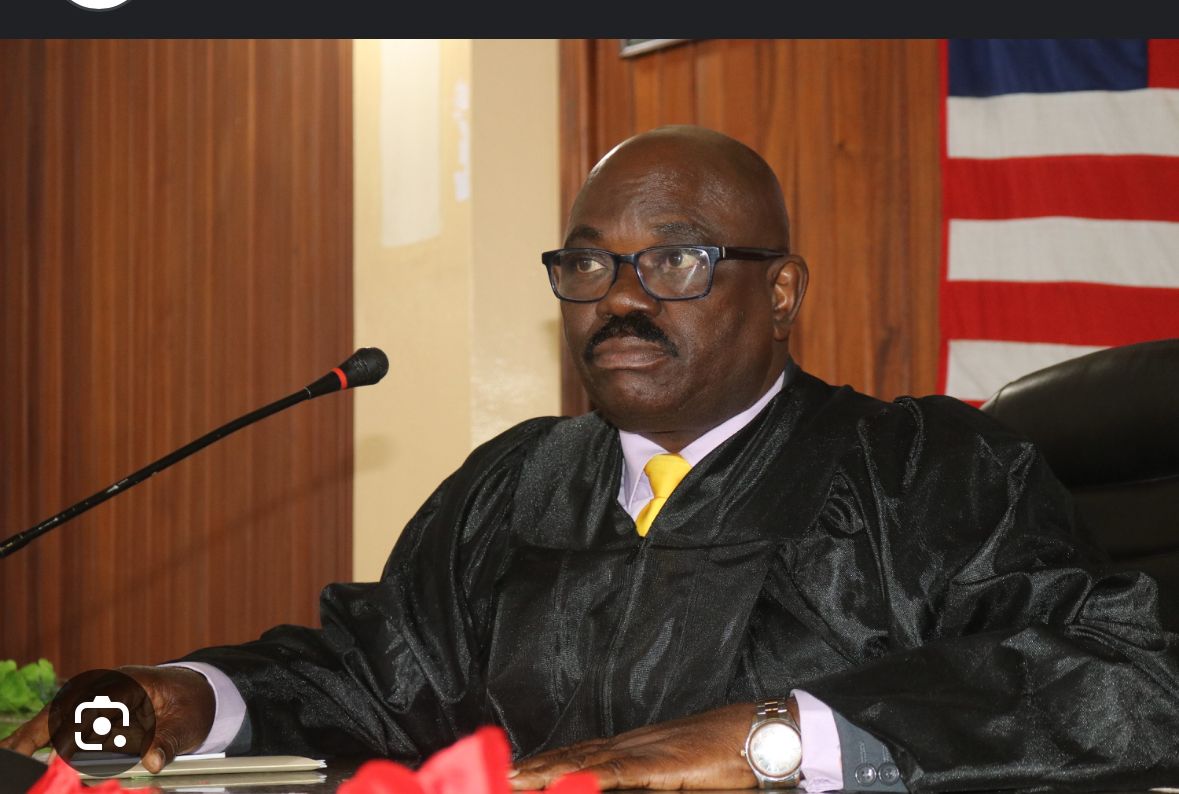
In a development that has sent shockwaves through the corridors of power in Monrovia, Judge Roosevelt Willie of Criminal Court “C” has officially denied a motion to dismiss the high-profile corruption case against former Finance and Development Planning Minister Samuel Tweah and four other senior officials of the immediate past administration. The ruling, delivered on Friday, February 28, 2025, serves as a pivotal inflection point in Liberia’s ongoing, often contentious, crusade against endemic corruption. By refusing to quash the indictment, Judge Willie has effectively greenlit a judicial process that seeks to hold the upper echelons of the previous government accountable for the alleged misappropriation of state resources, setting the stage for a trial that will undoubtedly be watched by international observers, civil society organizations, and the Liberian citizenry alike. The legal battle involves a constellation of former officials, including former Solicitor General Cllr.
Nyenati Tuan, former Central Bank of Liberia Executive Governor Stanley S. Ford, former Deputy Minister of Internal Affairs D. Moses P. Cooper, and former National Security Advisor Jefferson Karmoh.
Together, these figures face a litany of grave criminal charges, including economic sabotage, theft of property, criminal facilitation, and conspiracy. At the heart of the litigation is the allegation that these officials orchestrated the unauthorized withdrawal of US$500,000 and L$1,055,152,540 from the Central Bank of Liberia. The prosecution maintains that these funds were ostensibly earmarked for the procurement of critical IT equipment for national security purposes, yet the state contends that the money vanished into a vacuum of accountability, never serving the intended national security objectives. The defense team for the accused had mounted a sophisticated legal challenge, arguing that their clients should be granted immunity from prosecution.
Their primary thesis was rooted in the functional nature of the National Security Council (NSC). The defense posited that the defendants were acting in their official capacities as members of the NSC, executing sensitive duties under the direction of the executive branch, and therefore should be shielded by the same constitutional protections afforded to the President. This argument sought to elevate executive directives to the status of absolute immunity, a move that would have set a dangerous precedent for future administrations. However, Judge Willie’s ruling was as definitive as it was sharp.
He dismantled the defense’s interpretation of constitutional immunity, clarifying that such protections are expressly reserved for the Head of State under Article 61 of the Liberian Constitution. Willie emphasized that immunity cannot be extrapolated or inherited by appointees, regardless of their role within the National Security Council. This judicial stance reaffirms the principle that in a constitutional democracy, no official—no matter how high-ranking or politically connected—is above the law. Yet, beneath the veneer of this strictly legal debate lies a roiling sea of political sentiment.
The case has become a focal point for the growing debate over the integrity of Liberia’s justice system, which has historically been perceived as a tool for the victor to settle scores with the vanquished. Critics of the current administration argue that the prosecution of Samuel Tweah and his colleagues is not a genuine pursuit of justice but a calculated political maneuver designed to discredit the Coalition for Democratic Change (CDC) and consolidate power by weakening political rivals. This sentiment echoes a persistent pattern in Liberian political history, where transitions of power are frequently marked by audits and subsequent corruption indictments against predecessors. For decades, Liberia has struggled to break the cycle of “victor’s justice.
” From the tumultuous years of the Tubman era to the post-war administrations of Taylor, Sirleaf, and Weah, legal proceedings against former officials are rarely viewed in a vacuum. They are analyzed through the lens of shifting allegiances and the perpetual search for legitimacy. Supporters of the accused argue that the administration of President Joseph Boakai, by focusing so heavily on the financial dealings of the previous regime, risks alienating a significant portion of the populace and deepening political polarization. They contend that the charges are trumped-up and serve as a distraction from the current government's own policy challenges and economic agenda.
Conversely, anti-corruption advocates and civil society groups see this trial as a litmus test for the Boakai administration’s “Rescue Mission” platform, which campaigned on the promise of transparency and accountability. For these supporters, the integrity of the judicial process is paramount. They argue that if the case proceeds to a fair and impartial trial, it could signal the beginning of the end for the culture of impunity that has plagued Liberia since its inception. The economic implications of this case are equally profound.
The amounts in question—nearly 1.5 billion Liberian dollars and half a million US dollars—represent significant capital in a nation struggling with inflationary pressures, high unemployment, and significant infrastructure deficits. The public perception that these funds were diverted for alleged security procurement, only to be misappropriated, resonates deeply with a population that is increasingly demanding that the government account for every penny of the national budget. The lack of transparency in previous IT procurements, particularly those involving national security, has long been a source of suspicion.
If the prosecution can prove the charges, it will expose the mechanisms through which public wealth has been siphoned off, potentially leading to reforms in how the state handles procurement in sensitive sectors. However, the road ahead is fraught with legal and political obstacles. A trial of this magnitude requires a level of judicial independence that has been difficult to sustain in Liberia’s past. As the case advances, the scrutiny will intensify.
Every motion, every ruling, and every witness testimony will be dissected by political pundits and legal experts. There is also the broader regional context to consider. Liberia is currently attempting to rebrand itself as a bastion of democratic stability in a West African sub-region that has seen a concerning rise in military coups and democratic backsliding. The success or failure of this trial will be noted by regional bodies like ECOWAS and international donors, who have long invested in strengthening the rule of law in Monrovia.
If the justice system is perceived to be acting under executive dictation, the damage to Liberia’s reputation could be long-lasting. If, however, the process remains transparent and adheres to the highest legal standards, it could bolster the country's democratic credentials. The question of whether this is “more political than legal” will likely remain an open debate long after the verdict is rendered. In the complex theater of Liberian politics, the courtroom is often just another venue for political maneuvering.
The true test for the judiciary will be its ability to withstand the external pressures that inevitably accompany such high-stakes litigation. For Judge Willie and the prosecution, the mandate is clear but the execution is incredibly difficult. They must navigate a landscape where every legal victory is framed as a political win, and every setback is characterized as a sign of corruption. As the trial commences, Liberia stands at a crossroads.
The outcome will not only determine the fates of five individuals but will also offer a clear indication of whether the nation is genuinely moving toward a system where the rule of law acts as a neutral arbiter, rather than a weapon of political warfare. The eyes of the nation are fixed on Criminal Court “C,” waiting to see if justice will truly be served, or if the case will dissolve into yet another chapter of Liberia’s cyclical political narrative.
