
The fire that gutted the legislative chambers of Liberia’s Capitol building was, in its immediate aftermath, a profound national tragedy—an architectural and symbolic wound to the heart of the nation’s democracy. However, as the smoke cleared, what emerged from the ruins was not a concerted effort to rebuild or to conduct a transparent forensic inquiry, but a deeply troubling political scandal. The government’s response to this catastrophe has evolved into a masterclass in the breakdown of the rule of law, showcasing a systemic abuse of state power and the cynical exploitation of a national crisis to settle long-standing political scores. The institutions historically tasked with the protection of the citizenry and the integrity of the state—the Liberia National Police (LNP) and the National Security Agency (NSA)—have become active instruments of coercion, trading the mantle of justice for the mechanisms of vengeance.
This shift signals a dangerous regression in Liberia’s democratic trajectory, one that mirrors the darker chapters of the nation’s post-conflict recovery. The investigation into the Capitol fire has been characterized from its inception by a vacuum of transparency that has eroded public trust. Suspects held in relation to the inquiry have alleged, through legal counsel and advocates, that NSA operatives engaged in brutal interrogation tactics, including physical beatings, death threats, and intense psychological pressure designed to force predetermined narratives. These allegations suggest a concerted effort not to uncover the technical origins of the blaze, but to fabricate a case that implicates prominent opposition lawmakers.
By weaponizing the investigative process, the state has hollowed out legal procedure, repurposing the courtroom as a stage for political performance rather than a temple of justice. Among the most high-profile figures entangled in this web are former House Speaker J. Fonati Koffa and fellow members of the Coalition for Democratic Change (CDC), including Dixon Seboe, Abu Bana Kamara, and Jacob Debee. While state officials persist in their claims that these indictments are built upon substantive evidence, constitutional scholars and rights advocates characterize the entire process as ‘political staging.
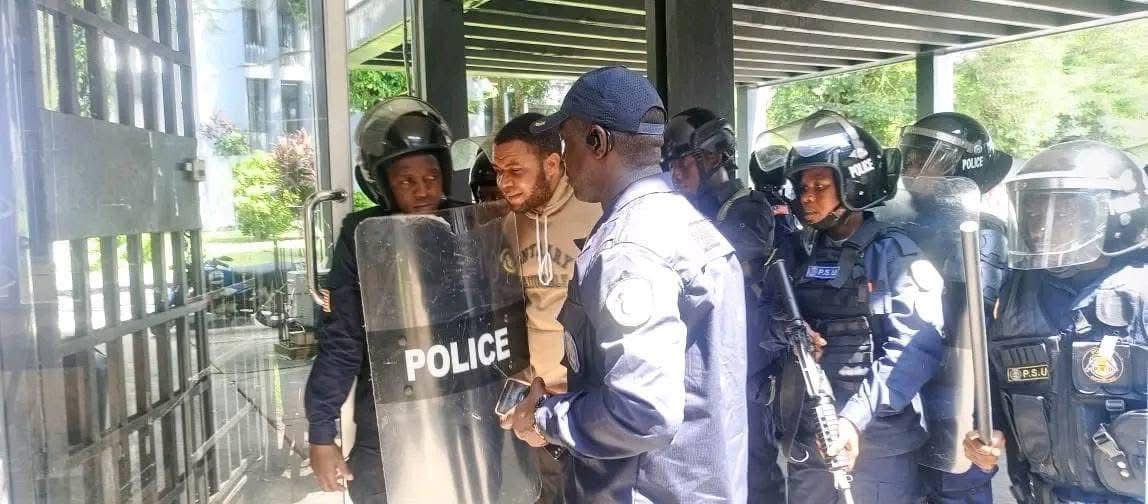
’ This strategy is not novel in the landscape of Liberian politics, where the judicial system has frequently been coerced into serving the executive branch. However, the intensity and blatant disregard for due process seen here represent a significant escalation in the erosion of institutional independence. The case of John Nyanti serves as the most harrowing illustration of this state-sponsored overreach. After fleeing to Ghana in a desperate attempt to escape the reach of those he feared, Nyanti was forcibly returned to Liberia on June 6, 2025.
This extraordinary rendition occurred in total defiance of formal extradition protocols, effectively kidnapping a citizen from the jurisdiction of a sovereign neighbor. Credible reports indicate that this operation was orchestrated through a collaboration between the NSA, the LNP, and a relative of the accused, Koffa Nyanti. Shortly after his role in facilitating the return, Koffa Nyanti was appointed as Ambassador Plenipotentiary and Special Envoy for Trade and Investment. To observers of the Liberian political landscape, this appointment is viewed as a blatant quid pro quo, a reward for his role in delivering the state’s key witness into the hands of an agency accused of torture.
Nyanti’s legal representatives maintain that he was promised immunity, financial compensation, and safe relocation to a European nation—promises that have vanished into the ether of government deceit. Instead, he has been held incommunicado in undisclosed locations, systematically denied access to his legal counsel, and subjected to unyielding pressure to provide false testimony implicating opposition lawmakers. Until his situation gained traction through sustained media exposure, which forced the state to present him in court, Nyanti spent twelve agonizing days under arbitrary house arrest in a hotel room, a clear violation of Article 21 of the Constitution of Liberia, which mandates due process and the right to judicial review of any detention. The silence from government officials regarding his status is not merely a lack of transparency; it is a tacit admission that their actions cannot withstand legal scrutiny.
The conduct of the NSA in this instance must be viewed through the lens of a broader institutional trend. Since 2010, the NSA has received over $151 million in public funding. This is a staggering sum for an agency operating within a country that maintains a score of zero on the Global Terrorism Index—indicating that, by international metrics, Liberia faces no credible terrorism threat that would justify such massive resource allocation. Yet, between 2024 and 2025 alone, the NSA’s budget soared from $9.
4 million to $14.9 million, with the agency brazenly overspending its 2024 allocation by $1.5 million. Most alarming is the growth of the ‘special operations intelligence’ line item, which has more than doubled.
These funds operate in a black hole, immune to independent audits and shielded from legislative oversight. Governance experts in Monrovia have noted that these funds are frequently redirected toward political witch-hunts and the maintenance of a luxurious lifestyle for the executive elite. Complementing this is the Liberia National Police, which saw its intelligence budget surge by 600% in the 2025 fiscal cycle. According to the 2025 State of Corruption Report published by the Center for Transparency and Accountability in Liberia (CENTAL), the LNP is now ranked as the most corrupt institution in the country, deeply entrenched in cycles of systemic bribery and political interference.
This corruption is not just administrative; it is philosophical. When the police force abandons the principle of impartiality to act as a partisan arm of the ruling party, the social contract between the state and the citizen is severed. The institutional neglect that allowed these agencies to operate with such impunity is a legacy of decades of fragile governance. However, the current administration has transformed this potential for abuse into a deliberate governing strategy.
By treating the law as a blunt instrument for the consolidation of power, the government is fostering a climate of fear that threatens to destabilize the hard-won peace Liberia has enjoyed since the conclusion of the civil wars. The regional implications of this are grave; as Liberia struggles to project itself as a stable democracy within the Mano River Union, the optics of a government using forced disappearances and extrajudicial detentions to silence political rivals invite condemnation from the international community and threaten donor confidence. As Liberia marks seven months since the fire consumed the legislative chambers, the nation finds itself at a crossroads. The government’s attempt to frame political opposition as enemies of the state is a dangerous game that risks inciting the very instability it claims to prevent.
The question remains: will the leadership recognize the damage they are inflicting upon the nation’s fragile democratic architecture, or will they continue to prioritize the survival of their regime over the rule of law? The legacy of the Capitol fire investigation will not be determined by the final verdict of the courts—which many now view as compromised—but by the lasting impact this period of lawlessness leaves on the collective conscience of the Liberian people. For now, the cries for justice remain drowned out by the orchestration of political retribution.
