
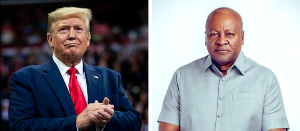
In an era defined by global economic volatility and shifting geopolitical tides, the political landscape is witnessing a fascinating, albeit controversial, phenomenon: the resurgence of former leaders. From the halls of Washington D.C. to the bustling political arenas of Accra, the return of Donald Trump to the White House and the formidable comeback bid of John Mahama in Ghana serve as stark reminders that the appetite for 'experienced hands' is growing.
This trend is not merely a nostalgic retreat to the past; it is a calculated response by electorates disillusioned with incumbent administrations that have, in their view, failed to navigate the complex challenges of the post-pandemic global economy. For Insights Liberia, analyzing these parallel narratives provides a vital blueprint for understanding how political comeback strategies are crafted, sustained, and ultimately executed in environments defined by high inflation, currency depreciation, and deep-seated socioeconomic grievances. The resurgence of these figures stems primarily from their capacity to articulate a compelling economic vision—one that speaks directly to the kitchen-table concerns of the average citizen, transcending traditional political rhetoric. Donald Trump’s victory was anchored in a potent cocktail of protectionist sentiment and tax relief, while John Mahama’s momentum in Ghana is buoyed by structural proposals aimed at job creation and fiscal reform.
These campaigns offer a masterclass in how former leaders can reposition themselves as the essential 'fixers' of national crises, particularly in contexts where citizens feel their quality of life has plummeted. Donald Trump’s successful path back to power was not a product of chance, but of a carefully calibrated platform that synthesized economic nationalism with a fierce defense of the American blue-collar worker. By promising a 10% across-the-board tariff on all imports and escalating to a 60% levy on Chinese goods, Trump tapped into a visceral desire among voters to protect domestic manufacturing and secure industrial sovereignty. This message was supplemented by a suite of tax-relief promises, including the elimination of federal taxes on tips, Social Security benefits, and overtime pay.
By framing these policies as direct injections of liquidity into the pockets of everyday Americans, he effectively neutralized accusations of economic elitism. Furthermore, his aggressive stance on immigration—centered on the promise of the largest deportation operation in U.S. history—served as a rallying cry for his base, providing a tangible, albeit highly contentious, solution to public anxiety regarding border security and social resources.
His campaign succeeded by ignoring the academic critique that such policies might widen the deficit, focusing instead on the immediate, emotional resonance of 'America First' in a time of persistent inflation. On the other side of the Atlantic, Ghana’s John Mahama approaches his comeback through a lens of systemic reinvention. His '24-hour economy' proposal represents a radical departure from traditional governance, aiming to harness productivity through a three-shift work system that could fundamentally reshape Ghana’s labor landscape. This is not merely an abstract economic concept; it is a targeted response to a staggering 14% unemployment rate that has driven a brain drain of young, talented professionals out of the country.
Mahama’s plan is backed by a $10 billion 'Big Push Initiative' intended to revitalize infrastructure, with a critical focus on private-sector ICT investments to catalyze the digital economy. Coupled with his promise to provide free primary healthcare across the district level and offer tax exemptions for Micro, Small, and Medium Enterprises (MSMEs), Mahama has successfully positioned himself as a steward of stability. His rhetoric is sharp, addressing a reality where Ghana has faced 54% inflation and a 70% currency depreciation over the past eight years—a performance record that current incumbents struggle to defend. While Trump and Mahama differ in ideology, their strategic focus on economic recovery is remarkably similar.
AP VoteCast data from the U.S. context revealed that nearly 3 in 10 voters felt they were 'falling behind' financially, with nearly 9 in 10 expressing acute distress over the rising costs of staples like groceries, gasoline, and housing. Trump’s strategy was to offer a direct, populist remedy to this pain.
Mahama, meanwhile, addresses similar anxieties through structural reform. By promising to establish national employment centers and utilizing tax incentives to connect the youth with employers, he attempts to bridge the gap between systemic failure and individual opportunity. Both leaders have recognized a fundamental truth of modern politics: when economic hardship becomes systemic, voters are less interested in the preservation of the status quo and more interested in the disruption of the current trajectory, even if that disruption comes from a leader who has served before. The anti-establishment narratives of these two figures highlight the different ways a leader can frame their return.
Trump remains the consummate disruptor, leaning into his 'outsider' status despite his four years in the Oval Office. He cultivates a persona of defiance against the 'Washington elite,' positioning himself as the only individual capable of purging the federal bureaucracy of the so-called 'globalists.' His campaign is not about refining the system; it is about tearing down the existing infrastructure of governance to make room for his specific brand of nationalist policy. Conversely, Mahama’s 'reset' narrative is institutional and disciplined.
He does not propose to break the state; he proposes to fix it. His campaign is steeped in the language of fiscal responsibility and debt sustainability. By promising forensic audits and a restoration of public trust in state institutions, he appeals to a demographic that is tired of chaos and craves efficiency. Mahama’s return is presented as a restorative act—an opportunity to restore the expertise that he argues has been squandered by his successors.
These distinctions offer critical cues for the Liberian political landscape as the country looks toward the 2029 election cycle. Liberia faces a daunting convergence of challenges: an inflation rate exceeding 50%, a multi-dimensional poverty rate surpassing 70%, and a youth unemployment crisis where over 90% of the demographic lacks access to formal work. The lesson for the Liberian opposition is clear: promises of abstract democratic ideals will not suffice when the infrastructure of daily life is crumbling. The country’s severe healthcare deficit—with only 0.
8 hospital beds per 1,000 people—and its dilapidated road networks are not merely logistical problems; they are political liabilities for any incumbent and major opportunities for a challenger. An effective opposition strategy in Liberia must mirror the precision of these comeback campaigns. This involves moving beyond vague slogans toward a comprehensive, granular economic development strategy. Proposals must include tangible pathways to business formalization, the incentivization of local manufacturing, and a cooperative model for agriculture that provides farmers with the tools to transition from subsistence to surplus.
Crucially, the opposition must demonstrate how tax reforms will specifically empower the 79.9% of the workforce currently languishing in the informal sector. A successful comeback strategy, as evidenced by Trump and Mahama, is not predicated on simply being the 'alternative'; it is about being the 'architect' of a new economic reality. It requires a delicate balance of deep experience and the courage to innovate.
Voters are not searching for perfect candidates; they are searching for candidates who demonstrate an understanding of their specific, daily struggles and who possess a credible roadmap to address them. For the aspiring leader, the path to power is through the wallet. By combining practical, actionable solutions—such as tax relief for small businesses, targeted infrastructure investment, and modernized labor policies—with a narrative that taps into the justifiable frustration of the electorate, opposition parties can transform dissatisfaction into a mandate for change. The takeaway for Liberia’s future is that voters respond to leaders who speak to their lived realities, rather than their political affiliations.
The comeback campaigns of the global stage remind us that when the promise of the future is eclipsed by the failure of the present, the electorate will inevitably look to the past for a way forward—provided that past is framed as a solution rather than a retreat.



