
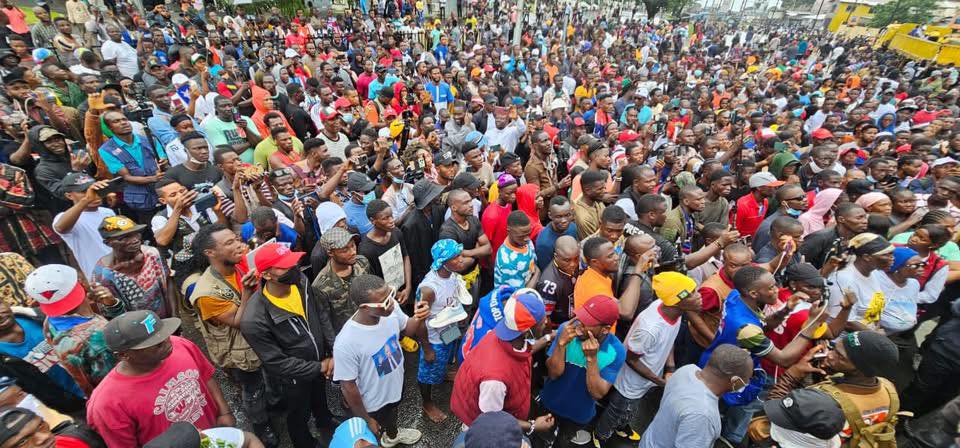
“Day of the People” — The Rise of the Suffering Masses: Liberia’s Streets Echo With the Cry for a New Beginning. On July 17, 2025, the heart of Monrovia underwent a seismic shift in its political climate as thousands of citizens braved a relentless torrential downpour to descend upon Capitol Hill. Organized under the banner of “The Day of the People” by the Solidarity Trust for a New Day (STAND), this assembly was far more than a mere gathering; it was a visceral manifestation of a growing existential crisis within the Liberian state. As the rain lashed against the asphalt, the diverse coalition—comprising market women from Waterside, university students, weary health professionals, motorbikers, and disillusioned civil servants—sent a singular, thunderous message to the seat of executive power: the social contract between the Liberian people and their government is fractured beyond repair.
This demonstration marks a defining inflection point in the administration of President Joseph Boakai, challenging the current leadership to reconcile its campaign promises of transparency with the harrowing reality of systemic decay. Historically, Liberian politics have been characterized by a cyclical tension between the elite in the executive mansions of Monrovia and the marginalized populations in the hinterlands and urban shantytowns. Following the dual trauma of the civil wars and the subsequent efforts at stabilization, the hope for a ‘New Liberia’ was supposed to be anchored in democratic consolidation. However, the events of July 17th suggest that the populace has lost patience with the slow grind of institutional reform.
The grievances aired were not merely complaints about high commodity prices or fuel shortages; they represented a profound rejection of a culture of impunity that has permeated every stratum of the civil service. The protesters, led by the firebrand activist and STAND Chairman Mulbah Morlu, articulated a grievance that has been simmering for years: the perception that public office has been transformed into a vehicle for private enrichment while the public infrastructure crumbles into dust. At the epicenter of these allegations is a deep-seated frustration with the perceived lack of accountability regarding the national budget. Critics argue that while billions of Liberian dollars pass through government agencies, the tangibles—durable roads, functional schools, and adequately stocked hospitals—remain elusive.
A nurse from the Sinkor district, standing amidst the throng, captured the collective exhaustion of the workforce: “We are tired of watching our leaders grow richer while our children go hungry and our hospitals remain empty.” This statement underscores the human cost of corruption, a phenomenon that has historically drained the national treasury and stifled foreign investment. The economic implications are severe. When the public sector is perceived as a closed loop of self-interest, the trickle-down effect of national wealth halts, leaving the ‘everyday hustlers’—the backbone of Liberia’s informal economy—to navigate a landscape of high inflation and dwindling purchasing power.
The demand for an immediate, comprehensive audit of state agencies is not merely a bureaucratic request; it is an economic necessity for a nation struggling to maintain the confidence of international donors and regional partners within the ECOWAS bloc. Furthermore, the demonstration illuminated the fragile state of law and order in the country. The explicit call for the resignation of Police Chief Gregory Coleman highlights a disturbing trend of heavy-handed policing that many feel mirrors the authoritarian past rather than a modern, rights-based democracy. The mention of the Kinjor massacre served as a rallying cry, drawing national attention to the unresolved nature of state-sanctioned violence.
In a country where the judiciary is often viewed as a handmaiden to the executive, the protesters’ demand for judicial independence is perhaps the most radical request on their platform. The perception that the courts are used to weaponize the law against political dissenters is a direct threat to the democratic process. Without a transparent, neutral arbiter to resolve disputes, citizens are forced into the streets to seek redress, perpetuating a cycle of public agitation and state securitization that hampers economic productivity. The juxtaposition of luxury lifestyles maintained by public officials against the backdrop of systemic poverty creates a combustible social environment.
In the context of West African political history, this disparity has often been the harbinger of instability. The protesters were not just asking for a raise in the minimum wage—though that is a pressing demand—they were asking for a fundamental shift in the moral philosophy of governance. They want a government that shares in the burden of the nation’s survival rather than one that occupies a separate, protected sphere of opulence. As security forces cordoned off government buildings with tactical barriers, the atmosphere remained disciplined yet expectant.
The organizers’ insistence on delivering a petition directly to President Boakai signaled a strategic desire for direct accountability. The 14-day ultimatum issued by the STAND leadership is a bold maneuver that places the ball squarely in the President’s court. It requires not just rhetoric, but concrete, verifiable action: the suspension of implicated officials, the launch of independent investigations into human rights abuses, and a clear, time-bound roadmap for the overhaul of public health and educational services. The regional significance of this protest cannot be overstated.
As Liberia navigates its path in a sub-region currently beset by military coups and governance crises, the stability of its democracy serves as a litmus test for the effectiveness of civil society in holding power to account through peaceful, constitutional means. If the government chooses to ignore these demands or responds with further repression, it risks alienating the very base it claims to represent. Conversely, if it adopts a policy of genuine structural reform, it could provide a blueprint for how nations in the Global South can navigate the transition from patronage-based systems to true representative democracy. The “Day of the People” has passed, but the echoes of that rain-soaked demonstration continue to resonate in the halls of power and the conversations of every street corner in Monrovia.
The movement has effectively set the terms of engagement for the coming months. Whether the Liberian government views this moment as a threat to be managed or a clarion call to be answered will determine the legacy of the current administration. For the masses, the choice is clear: they are no longer willing to wait for the benefits of statehood to materialize in the distant future. They are demanding a new beginning today, insisting that the promises of democracy be reflected in the quality of their daily lives.
The eyes of the international community, from the regional offices of the African Union to the diplomatic missions in Monrovia, are watching closely. The question remains: will the Boakai administration rise to the challenge of reform, or will this moment be lost to the inertia of the status quo? For now, the people have spoken, and their demand for “Justice, Dignity, and a New Liberia” remains the defining issue of the day.



