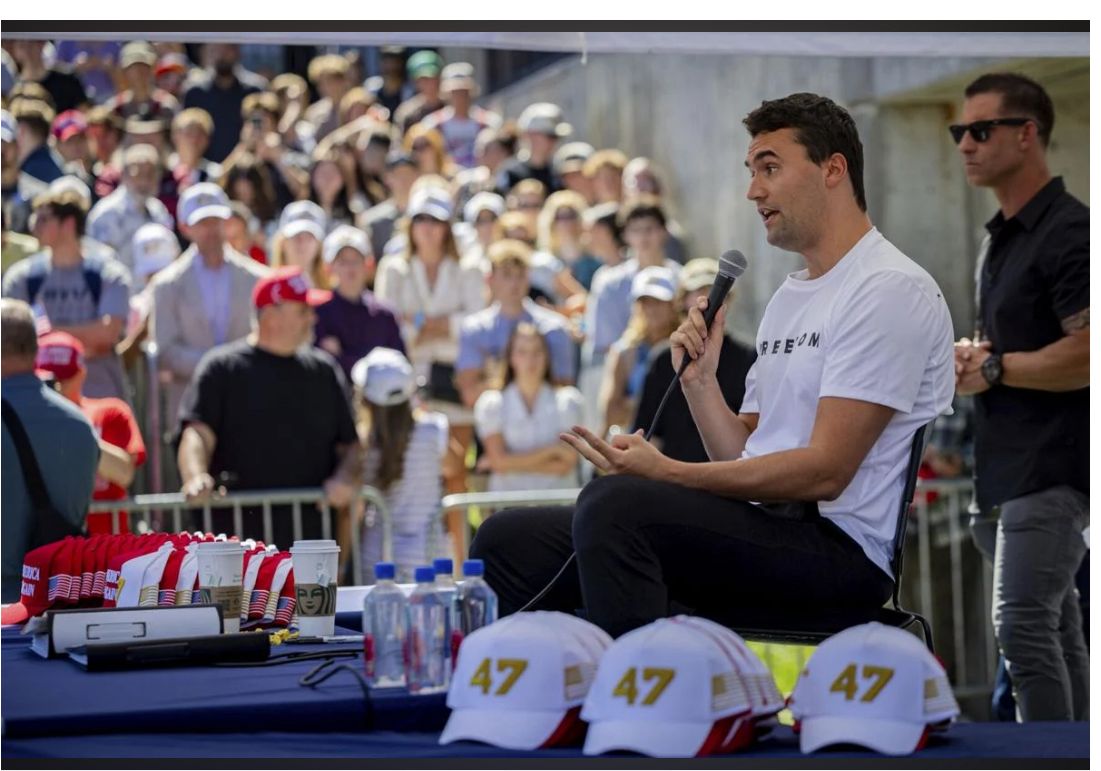
The landscape of American political discourse was irrevocably altered this past Wednesday when Charlie Kirk, the 31-year-old firebrand founder of Turning Point USA, was assassinated during a speaking engagement at Utah Valley University. The incident, which unfolded in broad daylight before a crowd of students, staff, and his own family, has sent shockwaves through the United States and prompted global reflection on the escalating toxicity of modern political polarization. For observers in Liberia, a nation that has historically grappled with the volatile intersection of rhetoric and violence, the news carries a sobering resonance. The brutal silencing of a voice, regardless of one’s ideological position, serves as a grim reminder of how quickly democratic debate can devolve into physical catastrophe.
Kirk, who had established himself as a central figure in the conservative youth movement, was addressing an outdoor gathering shortly after midday when a single, fatal gunshot silenced him, turning a platform of debate into a scene of national tragedy. The subsequent pandemonium, as students and attendees scrambled for cover, marks a dark chapter in the history of American campus activism. The swift response from local law enforcement and federal agents underscores the severity with which the United States government is treating this breach of public security, yet the absence of a declared motive or a suspect profile as of late Wednesday evening leaves a dangerous vacuum of information. From a Liberian perspective, the institutional stability of universities as crucibles of intellectual growth is paramount.
When educational institutions, often seen as the last bastions of civil disagreement, become war zones, the foundational pillars of democratic dialogue begin to crack. The death of Kirk, a man whose career was defined by his ability to provoke and mobilize, raises profound questions about the nature of political accountability and the dangerous erosion of norms in a digital age where echoes and outrage too often supersede compromise. Turning Point USA, under Kirk’s leadership, became a powerhouse of conservative organization, known for its aggressive campaigns on college campuses across the country. His methods were often described as confrontational, intentionally challenging the prevailing liberal orthodoxy in American academia.
Yet, whatever one thought of his tactics, the use of lethal force to settle a political score represents a fundamental rejection of the democratic process. In the history of Liberia, we have seen how political hyper-polarization can lead to devastating cycles of violence. During the Liberian Civil War and the subsequent periods of political transition, the nation learned the high cost of silencing dissent through force rather than through the ballot box or the forum of ideas. The American experience, though distinct in its institutional maturity, now mirrors some of the precarious tensions that define fragile democracies worldwide.
The presence of Kirk’s wife and children at the scene adds an unimaginable layer of personal trauma to the public catastrophe. It underscores the reality that political figures are not merely vessels for ideology; they are human beings whose movements are increasingly fraught with mortal risk. The lockdown of Utah Valley University for the remainder of the evening was a necessary, if chilling, measure of precaution. As federal authorities continue to sift through evidence, the task of understanding the perpetrator’s intent becomes the primary focus of the national intelligence apparatus.
Was this the act of a radicalized individual, a coordinated political hit, or the spontaneous escalation of a grievance gone wrong? The lack of clarity has only fueled the flames of speculation, with digital platforms erupting in theories that further complicate an already fractured national conversation. The economic and social implications of this event are significant. The movement Kirk led had grown into a multi-million dollar enterprise, influencing local school boards and university policies across several states.
His sudden absence leaves a void in the conservative ecosystem, likely triggering a struggle for influence and direction within the factions he cultivated. Furthermore, the event forces universities across the U.S. to re-evaluate their security protocols.
The notion of the 'open campus' is being challenged by the reality of the ‘secured campus,’ a transformation that has real-world consequences for the exchange of ideas. In the context of Liberia’s budding political scene, where youth activism is increasingly influential, the lesson from Utah is clear: the safety of those who participate in the political arena is a prerequisite for a functioning state. When public figures are targeted, it creates a climate of fear that discourages participation from the very youth that democracy relies upon for its renewal. As we look at the international reaction, the assassination of a high-profile activist serves as a cautionary tale for those who believe that words have no consequences.
The link between increasingly incendiary language and real-world violence is a subject that sociologists and political scientists have debated for years, but the tragedy at Utah Valley University provides a tragic, irrefutable data point. The international community, including observers in West Africa who follow American trends closely, must consider how the global export of political division impacts regional stability. The United States has long been a model for the peaceful transition of power and the endurance of speech, but this event, added to a string of recent political violence in the U.S.
, suggests a shift in the American paradigm. Whether this incident becomes a catalyst for legislative change or a footnote in a deepening divide remains to be seen. For now, the academic community at Utah Valley University, and indeed the entire nation, remains in a state of mourning and high alert. The death of Charlie Kirk is not just the death of a man; it is a manifestation of a systemic failure to keep the political arena a place of civil, rather than lethal, engagement.
As federal investigators continue to interview witnesses and analyze forensic evidence, the public is left to grapple with the haunting images of a day that began with policy debates and ended with a casket. At Insights Liberia, we believe that the preservation of civil society requires a rejection of violence at every turn, especially when that violence is aimed at the core of our democratic institutions. The search for a motive, the identification of the perpetrator, and the long-term impact on political discourse are matters that will concern not only the United States but the entire global community for months to come. We continue to monitor the investigation as it unfolds, awaiting official details on the suspect’s identity and the underlying cause of this senseless loss of life.
We invite our readers to consider the deeper implications of this event—how do we, as citizens of our respective nations, maintain the space for passionate disagreement while ensuring the absolute safety of those who dare to step into the public eye? The answers to these questions are the bedrock upon which our collective future is built, and it is a responsibility that cannot be delegated to the authorities alone. It requires a commitment from the citizenry to uphold the value of life above the value of the argument, and to recognize that once the threshold of violence is crossed, the possibility for meaningful change is often the first casualty. As the dust settles in Utah, the world watches, waiting for a signal that the democratic spirit can survive this trauma, or if this marks the beginning of an era of irreversible political fracturing.