
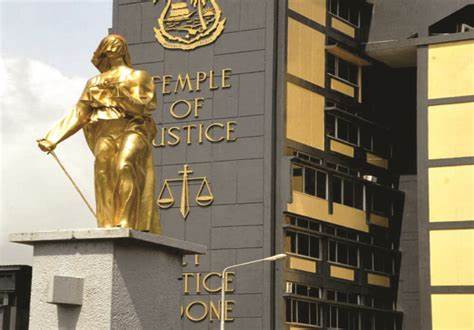
The corridors of the Temple of Justice in Monrovia have once again become the epicenter of a political and legal firestorm, as the Supreme Court of Liberia has issued a formal stay order on the high-profile economic sabotage case involving several former high-ranking government officials, most notably the former Minister of Finance and Development Planning, Samuel Tweah. This judicial intervention effectively brings a screeching halt to the ongoing trial proceedings, specifically freezing the critical jury selection process until further notice. The implications of this development are profound, signaling a potential shift in the trajectory of the current administration’s efforts to prosecute alleged instances of corruption linked to the previous Weah-led regime. As the nation watches, the judiciary finds itself squarely at the intersection of political accountability and constitutional due process, with the upcoming conference on March 10, 2025, now serving as the decisive juncture for the case.
To understand the gravity of this stay order, one must first appreciate the historical backdrop of Liberia’s justice system, which has long grappled with the shadows of political influence. Corruption cases involving former officials are rarely viewed as purely legal matters; they are frequently interpreted by the public as barometers of the current government’s commitment to transparency or, conversely, as instruments of political vendetta. The presence of figures like Samuel Tweah, who served as a central pillar of the Coalition for Democratic Change (CDC) government, elevates this case to a matter of national interest. The accusation of economic sabotage—a charge that carries severe punitive measures under Liberian law—is not merely an allegation of theft but an assertion that the state’s fiscal integrity was compromised, thereby damaging the collective welfare of the Liberian populace.
The Supreme Court's decision to grant the writ of prohibition, filed by the defendants, suggests that the high court intends to meticulously review the procedural path taken by the lower courts. In the Liberian legal tradition, a writ of prohibition is an extraordinary remedy. By invoking it, the defendants are arguing that the trial court either exceeded its jurisdiction or committed a fundamental error that could irreparably damage their rights to a fair trial. The Supreme Court’s willingness to entertain this petition indicates that there is at least a prima facie concern regarding whether the state has adhered to the stringent protocols required for such a complex prosecution.
This move by the high court is being interpreted by legal analysts as a cautionary, albeit necessary, step to ensure that the rule of law is not sacrificed in the pursuit of political expediency. In many post-conflict societies, the temptation to rush through corruption trials to satisfy public demand for 'justice' can lead to procedural shortcuts. If the state fails to build an airtight case that survives judicial scrutiny at the highest level, the entire effort risks being branded as a witch hunt. This has been a recurring theme in Liberia’s recent political history, where transitions of power are often followed by investigations into the previous administration, creating a cycle of suspicion that spans years.
The defendants’ legal team has consistently maintained that the charges lack evidentiary substance, suggesting that the prosecution is a politically motivated effort to discredit the CDC’s legacy. Conversely, proponents of the government’s actions argue that the nation’s dwindling coffers were the direct result of fiscal mismanagement and intentional sabotage by those entrusted with the nation’s wealth. The economic implications are staggering; as the country struggles with inflation, high unemployment, and the challenge of attracting foreign direct investment, the perception of fiscal corruption acts as a deterrent to international partners. The case is also emblematic of broader structural tensions between the executive, legislative, and judicial branches of the Liberian government.
Throughout the Weah era and into the current administration, the judiciary has frequently been called upon to mediate disputes that are inherently political. The current power struggle within the House of Representatives, which has seen legislative functions grind to a halt due to infighting, further complicates the political climate surrounding this trial. As the Supreme Court gears up for the March 10 conference, the atmosphere is charged with anticipation. The conference is expected to be more than a mere administrative gathering; it is effectively a mini-trial on the merits of the procedural challenges raised by the defendants.
Should the court decide to lift the stay order, the case will proceed to trial, likely setting the stage for a drawn-out legal battle that could stretch well into the following year. If the court upholds the prohibition, it could potentially derail the prosecution, casting doubt on the government's ability to hold high-level officials accountable for fiscal crimes. This case is not happening in a vacuum. It follows a long line of legal battles that have tested the resilience of Liberia’s institutions.
From the controversies surrounding the HPX framework agreement to the persistent debates over the management of state-owned enterprises, the theme of fiscal transparency remains a dominant concern. The regional significance cannot be overlooked either. As the Economic Community of West African States (ECOWAS) continues to advocate for democratic stability and the rule of law across the sub-region, the efficacy of the Liberian judiciary in handling such cases is being closely observed by regional partners. The credibility of Liberia’s democratic institutions rests on the outcome of this case.
For the public, the wait for the March 10 conference is a test of patience and faith. There is a palpable fatigue among citizens regarding the slow pace of justice, yet there is also a desire for a definitive conclusion—one that is based on facts rather than rumors or political maneuvers. As this story continues to develop, Insights Liberia will remain at the forefront of tracking the legal filings, the testimonies, and the political reverberations. The upcoming conference will undoubtedly provide the clarity that is currently lacking, but it will also likely trigger a new wave of discourse regarding the power of the Supreme Court and the limitations of the Executive’s reach in Liberia.
Whether this case results in a landmark ruling on economic crime or becomes another footnote in the history of stalled prosecutions will depend entirely on the upcoming judicial proceedings. For now, the gavel has been silenced by the stay order, leaving the fate of the defendants and the integrity of the process in the hands of the Honorable Justices of the Supreme Court.
