
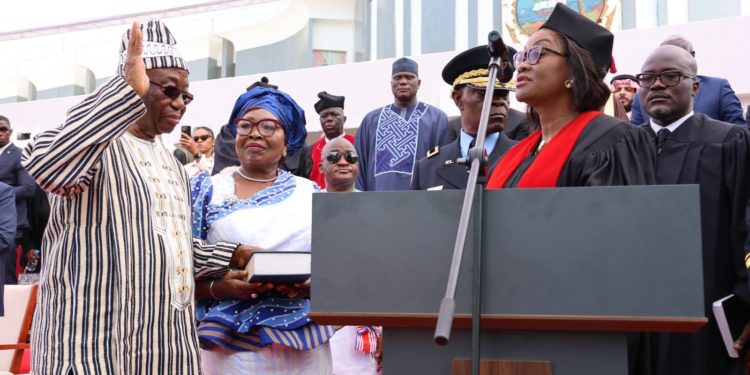
President Joseph Boakai's recent signing of the Fiscal Year 2025 National Budget has sent shockwaves through the foundations of Liberia’s fragile democracy. In a move that observers and legal experts characterize as a profound breach of constitutional protocol, the President has effectively prioritized executive expediency over the sanctity of the separation of powers. By signing a budget document birthed from the controversial and highly disputed 'Majority Bloc' of the House of Representatives—deliberately bypassing the lawfully elected Speaker, Fonati Koffa—Boakai has plunged Liberia into a constitutional crisis that threatens the very integrity of the rule of law. This decision is not merely a technical error; it is a signal of a deepening systemic malaise that risks undoing years of post-war democratic consolidation.
The controversy began when the Executive Mansion, under President Boakai’s direction, opted to submit the draft budget to a splinter group of lawmakers claiming to be the 'Majority Bloc' through the office of the Chief Clerk, rather than through the formal channel of the Speaker’s office. This maneuver violated established constitutional procedures, specifically the requirement that the Speaker of the House serves as the primary conduit for legislative communication with the Executive branch. By legitimizing a splinter faction that has bypassed the Speaker, the President has effectively sanctioned the subversion of internal parliamentary rules, a dangerous precedent in a nation where the executive has historically overshadowed the legislature. The 'illegal' nature of this approval process casts a dark shadow over the fiscal document itself.
A national budget is the most critical tool of governance, representing the allocation of public resources toward national priorities. When such a document is rushed through a process lacking transparent debate, committee review, and the standard scrutiny of a full, functioning House, the democratic legitimacy of the entire fiscal plan evaporates. This hurried enactment threatens the country’s fiscal stability, as the lack of due diligence could lead to inefficient resource allocation and a complete lack of accountability regarding how the people's money will be spent throughout the 2025 fiscal year. Former Supreme Court Associate Justice Kabineh M.
Ja’nah has taken a firm stand, signaling his intent to challenge the constitutionality of the budget in the highest court of the land. His intervention underscores the existential threat this situation poses to the Liberian constitution. A legal battle of this magnitude will inevitably paralyze government operations, creating a state of fiscal limbo. If the Supreme Court ultimately finds that the process was procedurally and constitutionally flawed, the government could face a total shutdown, with no legal authority to expend public funds.
This potential fallout would be catastrophic for a nation still struggling with post-pandemic economic recovery and high levels of food insecurity. Furthermore, the main opposition, the Congress for Democratic Change (CDC), has escalated the rhetoric, labeling the President’s actions as 'treasonous.' They argue that by signing a budget passed by a group that does not constitute a legal quorum of the full House, Boakai has actively participated in the subversion of the democratic order. While 'treason' is a heavy legal term, the sentiment reflects the depth of political polarization and the growing perception that the Executive is weaponizing legislative infighting to consolidate power.
This is a far cry from the reform-oriented governance that Boakai promised during his campaign. By violating his oath of office—which mandates that he uphold the Constitution and protect the institutions of the state—the President risks losing the moral authority required to lead. His actions suggest a departure from the collaborative approach necessitated by a divided government, favoring instead a ‘might makes right’ strategy that disenfranchises those who did not vote for his administration. The regional implications are equally concerning.
ECOWAS, through the interventions of Speaker Rt. Hon. Hadja Memounatou Ibrahima, has signaled grave concern over the deepening instability in Monrovia. The presence of regional mediators is an indictment of the Liberian political class’s inability to resolve its own internal crises.
If a sovereign nation cannot manage the basic constitutional requirement of passing a budget without descending into chaos, it signals to international investors and development partners that Liberia remains a high-risk environment. The economic fallout is already becoming apparent; in an era where foreign direct investment is essential to address Liberia’s infrastructure deficit, the perception of lawlessness and executive overreach acts as a deterrent. Investors demand a predictable legal framework and clear adherence to the rule of law. When the head of state is seen disregarding constitutional norms, it creates a ‘chilling effect’ on the business climate, potentially driving away capital and further stifling economic growth.
The legislative impasse also threatens the implementation of the new tax systems and the controversial adjustments to withholding taxes on consultancy services. Without a legitimately passed budget, the legal authority to collect these taxes is on shaky ground. This could lead to a massive revenue shortfall, forcing the government to either borrow unsustainably or slash essential public services, which would disproportionately affect the most vulnerable segments of the Liberian population. The historical context of this crisis cannot be ignored.
Liberia’s journey from a brutal civil war to a democratic state was predicated on the strengthening of institutions. The 1986 Constitution was specifically designed to ensure that no single branch of government would hold absolute power. By sidelining the Speaker, the President is not just fighting a political opponent; he is weakening the institution of the Legislature itself. This reflects a troubling historical cycle in Liberia, where Presidents often use their influence to fracture the opposition or manipulate legislative bodies to ensure loyalty, rather than fostering a system of checks and balances.
The ongoing mediation by ECOWAS and the prospect of Supreme Court intervention represent the final barriers between constitutional order and complete political collapse. The Supreme Court is now in a position where its ruling will either reinforce the primacy of law or serve as a tool that could further embolden executive overreach. If the court validates a process that ignores parliamentary procedure, it effectively renders the legislature a rubber stamp for the presidency. If it strikes the process down, it forces the government to reset, potentially requiring a national reconciliation effort to get the legislature functioning again.
As we look ahead, the coming weeks will define the remainder of President Boakai’s term. The citizenry is watching, and the political volatility is palpable. The administration has a choice: continue to push through the agenda using extra-constitutional means, which will invite further unrest and international condemnation, or acknowledge the procedural failure, pause, and seek a legitimate legislative consensus. Navigating this challenge requires a level of statesmanship that has, thus far, been absent from the budget process.
If Liberia is to survive this crisis with its democratic integrity intact, the President must move beyond the current confrontational stance. The stability of the nation, the strength of the economy, and the future of its democratic journey hang in the balance. The rule of law is the backbone of any functioning democracy, and when that backbone is bent, the entire body politic suffers. Liberia stands at a crossroad, and the decision to sign this flawed budget may well be remembered as a turning point—either toward reform or toward the erosion of the democratic ideals for which so many Liberians have sacrificed.
