
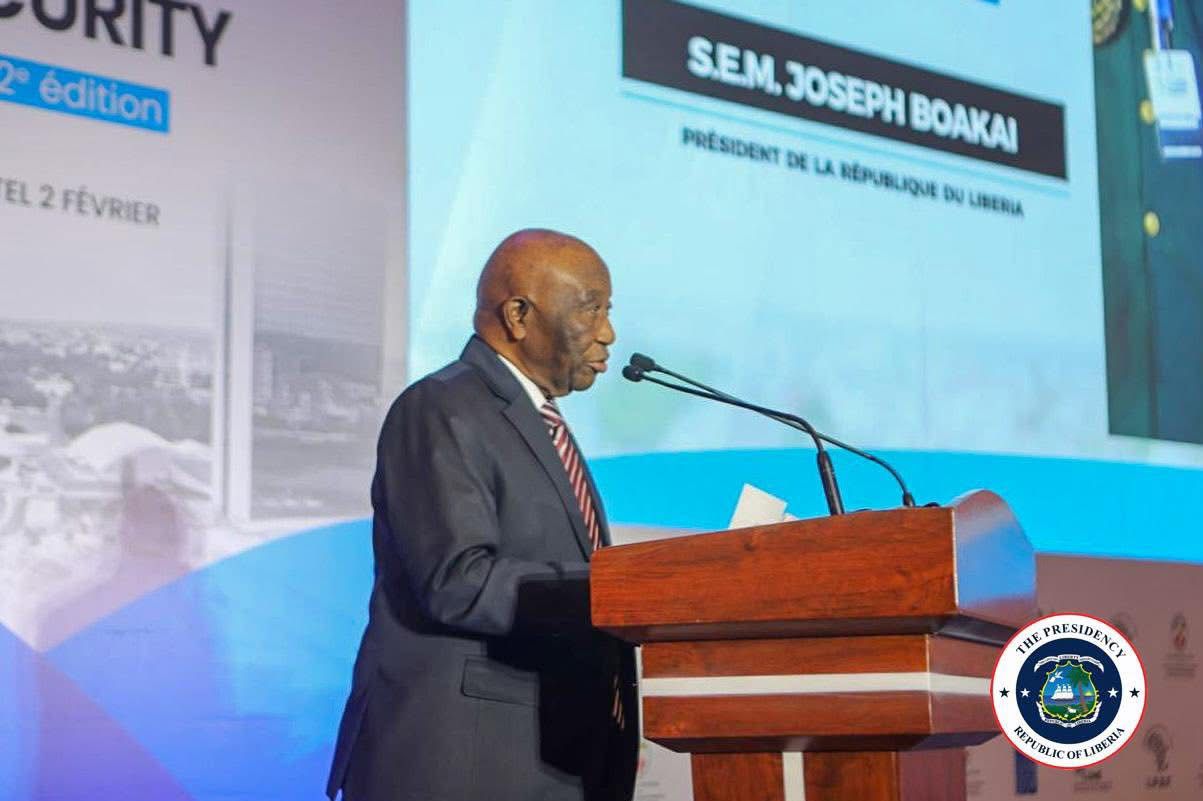
On October 11, President Joseph N. Boakai ascended the global stage at the 2nd Lomé Peace and Security Forum in Togo, projecting the image of a seasoned statesman committed to the tenets of democratic governance. Addressing a gathering of African leaders, he spoke eloquently of the imperative for forgiveness, the sanctity of political dialogue, and the necessity of forging national unity to safeguard the future of the continent. His rhetoric was punctuated by calls for a departure from the divisive politics that have historically plagued post-conflict nations.
Yet, for those observing the domestic landscape of Liberia, the contrast between the President’s international persona and the chilling realities unfolding in Monrovia could not be more stark. There exists a growing perception that the administration is operating behind a dual mask: one designed for the global press and the international donor community, and another characterized by exclusion, selective justice, and an uncompromising stance toward political rivals. This disconnect has sparked a profound debate over the sincerity of the 'Rescue Mission' that swept the Unity Party into power, as Liberians grapple with the unsettling feeling that the path toward democratic consolidation is being paved with exclusionary maneuvers. The incident involving former President George Manneh Weah at Roberts International Airport in February 2024 serves as a potent microcosm of this broader administrative hostility.
Upon his return to Liberia, Weah, the man who oversaw the peaceful transition of power in 2023, found the doors of the newly inaugurated presidential VIP lounge firmly locked against him. This was not a minor logistical oversight; it was a deliberate, symbolic snub. The lounge had been commissioned by Weah himself just weeks prior, intending to elevate the status of Liberia’s primary gateway. Security personnel on the ground, clearly rattled by the sensitivity of the situation, confirmed that the instruction to bar the former leader came from the highest levels of the executive branch.
During the previous administration, Weah had set a precedent of relative magnanimity, allowing members of the previous Ellen Johnson Sirleaf administration access to state facilities. By contrast, the Boakai administration’s move to deny a former Head of State access to his own creation reflects a petty, vindictive streak that undermines the norms of democratic transition. It signaled to the public that the spirit of 'forgiveness' preached in Togo had not crossed the borders of the Executive Mansion. This pattern of alienation reached a fever pitch in August 2025, when the political temperature in Monrovia surged to dangerous levels.
In the pre-dawn darkness of a quiet Tuesday morning, police officers and court sheriffs descended upon the headquarters of the Congress for Democratic Change (CDC) in Congo Town. The operation, ostensibly grounded in a legal ruling favoring the Bernard estate regarding the land ownership of the property, resulted in the violent eviction of the nation’s largest opposition party. For twenty years, the CDC had occupied this space, turning it into more than just an office—it was a symbol of political resistance and, later, the heart of the ruling party during the Weah years. To witness the demolition of the structure while supporters looked on, their pleas for dialogue disregarded, was a chilling reminder of how quickly political fortunes can turn into targets.
The CDC leadership decried the timing—coming in the wake of mounting economic frustrations—as a transparently politically motivated maneuver designed to dismantle the infrastructure of the opposition. The silence from the Executive Mansion following the demolition was deafening. By failing to offer a narrative of due process or seeking a mediated resolution, the government essentially endorsed the perception that legal machinery is now being weaponized to settle political scores. This is a recurring ghost in Liberia’s history; the nation has suffered too long from the 'winner-take-all' mentality that has historically excluded opponents from the body politic.
Liberia’s transition to peace since 2003 has been hailed as a model for West Africa, yet that peace remains fragile, resting on the belief that institutional mechanisms will remain neutral. When the police, the courts, and the executive office appear to act in concert to weaken a single political faction, the legitimacy of those institutions begins to erode. Beyond the individual instances of the airport lounge and the Congo Town eviction, there is a pervasive anxiety regarding the systemic purging of the civil service. Since the inauguration, allegations have surfaced repeatedly that professionals perceived to have ties to the former ruling party are being marginalized or summarily dismissed under the guise of restructuring.
This 'spoils system' approach to governance threatens to hollow out the civil service of institutional memory and experience. It suggests that the administration is prioritizing ideological purity over competence, a strategy that historically leads to administrative paralysis and increased corruption. Social implications are already manifesting as a sense of disenfranchisement among a large segment of the population that feels the current government does not represent their interests. If the civil service becomes a bastion for the winning party, the incentive for professional, merit-based governance disappears.
Economically, this creates a state of volatility. Investors are wary of environments where the legal and political ground is constantly shifting beneath their feet. When a party can be evicted from its headquarters based on contested land claims, it sends a signal to the private sector that property rights are secondary to the political whims of the state. This does not foster the economic stability or the foreign investment that Liberia so desperately needs to tackle its high unemployment and poverty rates.
The regional context is equally vital. ECOWAS, the regional bloc tasked with maintaining democratic order in West Africa, has struggled to contain the wave of military coups and political crises in the Sahel and surrounding nations. In this climate, the stability of a nation like Liberia is paramount. Yet, as ECOWAS advisor Jean-Claude Ayité aptly stated, leaders must reconcile their rhetoric with reality.
When a President advocates for regional peace but presides over a domestic environment of exclusion, he weakens his own mandate to serve as a beacon of democratic virtue. The 'homegrown' solutions for peace, which rely on national dialogue and internal cohesion, are rendered moot if the government itself is the primary engine of division. For the administration to reclaim its moral authority, it must move beyond the optics of international forums and address the structural issues of inclusion at home. This means ensuring that the judiciary operates free from the shadow of the executive, that the civil service is protected from partisan purges, and that former leaders and opposition parties are treated with the dignity required of a functioning democracy.
Until then, the call for unity in Lomé will continue to ring hollow. The question remains: can President Boakai pivot from the politics of retribution to the politics of genuine reconciliation? The history of post-conflict Liberia is littered with the remnants of leaders who failed to realize that their true strength lay in their ability to embrace those with whom they disagreed. As the nation looks toward the coming election cycles, the choices made today by the current administration will define not just their legacy, but the long-term health of the Liberian democratic experiment.
If the path of exclusion remains the primary strategy, the government risks alienating a significant portion of its citizenry, potentially setting the stage for deeper social unrest. A truly 'rescued' Liberia cannot be built by shutting doors at the airport or demolishing the halls of the opposition. It requires a commitment to the difficult, often uncomfortable work of dialogue. Until we see a shift in the administration's domestic policy, the two faces of the Boakai presidency—the diplomat abroad and the strategist at home—will remain an indictment of his administration’s true priorities.
