
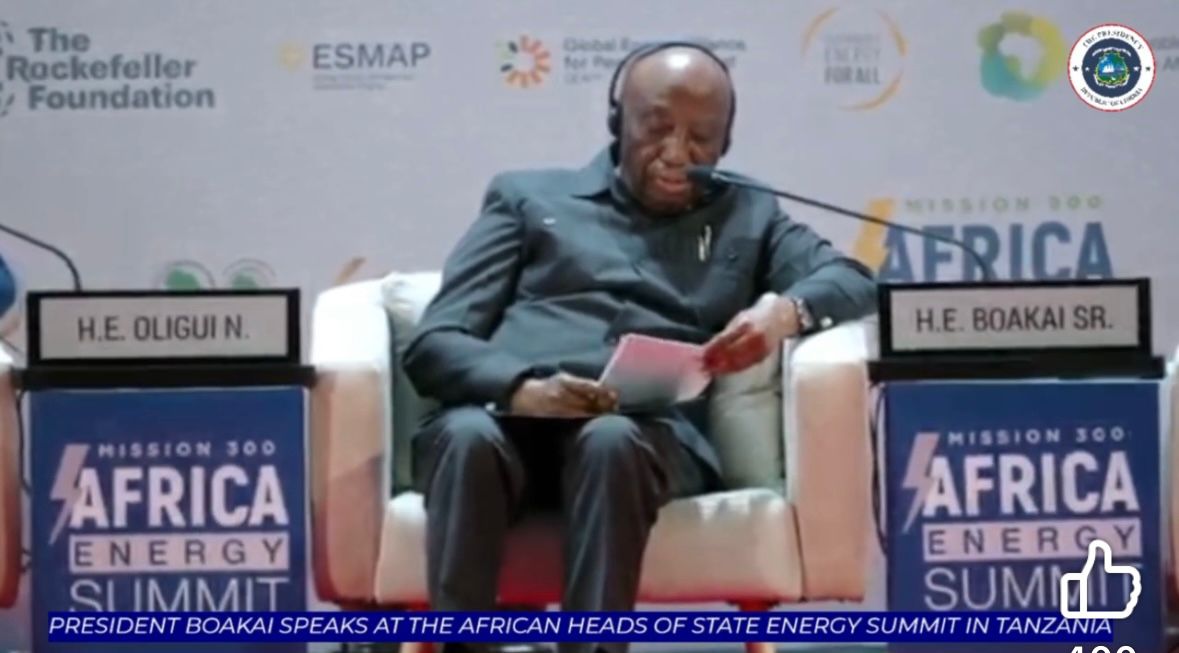
President Joseph Boakai’s recent appearance at the Mission 300 Africa Energy Summit in Tanzania was intended to serve as a pivotal moment for Liberia’s post-war reconstruction and development agenda. As the global community rallied behind a staggering $50 billion commitment to address the chronic electricity deficits plaguing the African continent, Liberia arrived with the stated objective of securing its share of this capital. However, the President’s performance left observers, potential international donors, and domestic critics alike concerned that the nation’s presentation was fundamentally misaligned with the high-stakes, technical nature of the summit. Instead of a display of bureaucratic precision and strategic foresight, the Liberian delegation’s engagement was characterized by a lack of focus, leading to a missed opportunity that could have lasting consequences for the country’s energy sector.
At a forum where national leaders were expected to deliver granular, bankable roadmaps for electricity infrastructure, President Boakai’s delivery appeared disjointed and detached from the urgency of the moment. The contrast between his rhetoric and the sophisticated, data-driven national compacts presented by peers—such as Kenya, Rwanda, and Ethiopia—was stark. These nations arrived with detailed feasibility studies, clear financial models, and actionable timelines, effectively positioning themselves to capture significant tranches of the available $50 billion fund. In contrast, President Boakai’s address was marked by anecdotal tangents, most notably a nostalgic recollection of a decades-old trip to Tanzania.
While personal diplomacy has its place in statecraft, the insertion of such sentiments into a high-level technical forum focused on renewable energy transitions, grid modernization, and private-sector investment was seen by many as a misuse of limited floor time. Such narratives, while potentially endearing in a local town hall setting, fail to translate into the language of multilateral development banks and institutional investors, whose interest lies solely in the viability of the project pipeline. Further compounding the issue was the President's reliance on colloquialisms such as 'gbem gbem' and 'small small thing' to describe the complex, systemic challenges facing Liberia’s power grid. In a climate where the nation is attempting to project an image of stability, professional maturity, and investment readiness, such informal phrasing served only to dilute the gravity of the mission.
When international partners evaluate the risk profile of a nation seeking massive infrastructure funding, they are looking for technical competence and professional rigor. The use of language that minimizes the scale of the energy crisis can inadvertently suggest a lack of appreciation for the technical, legal, and financial hurdles that must be cleared to successfully scale electricity access. The disappointment surrounding the President's speech is further exacerbated by the fact that Liberia was selected as a pilot nation for the ambitious 'Mission 300' initiative, a program designed to electrify 300 million people across the continent by 2030. Given this status, one would expect the highest level of preparation from the Liberian delegation.
Yet, during the summit, a palpable communication gap emerged. As other leaders articulated clear frameworks for cross-border power sharing, regulatory reform, and private investment attraction, the Liberian side struggled to articulate a basic, coherent national energy strategy. This confusion was particularly evident in the overlap between the government's domestic 'ARREST Agenda' and the specific requirements of the international Energy Compacts demanded by the summit organizers. The failure to reconcile these two frameworks in a clear, persuasive manner suggests a breakdown in the preparatory work required before such a high-level summit.
The role of the President’s speechwriters, policy advisors, and the Ministry of Mines and Energy in failing to synthesize these directives remains a point of significant scrutiny. It was reported that the moderator of the event was forced to intervene and truncate the President's remarks—a rare occurrence for a head of state and a clear signal that the presentation had lost its focus. For Liberia, a country where a significant majority of the population remains off-grid, the success of the Mission 300 initiative is not merely a matter of prestige; it is a matter of fundamental economic survival. The government has set an ambitious target of electrifying 100,000 households annually, a goal that requires massive external financing, consistent policy implementation, and a reputation for reliable governance.
If the international community loses confidence in the administration’s ability to communicate its needs and manage large-scale projects, that funding will inevitably flow to more prepared, articulate, and organized regional competitors. The historical context of the Liberian energy sector cannot be ignored. Following decades of civil war that decimated the nation's infrastructure, the subsequent years have been defined by a slow, often frustrating attempt to rebuild the Liberia Electricity Corporation (LEC). Corruption, transmission losses, and a lack of consistent, affordable power have historically acted as a stranglehold on the nation's industrial development.
Business leaders in Monrovia frequently cite the high cost of fuel-based power generation as the single biggest barrier to growth. Therefore, the Tanzania summit represented a rare window to bypass traditional local obstacles through multilateral, donor-backed reform. By appearing underprepared, the current administration risks alienating partners like the World Bank, the African Development Bank, and private institutional investors who are currently vetting which countries are 'investment-ready.' This incident also highlights a growing public outcry regarding the management of high-level diplomatic missions.
Criticism has been mounting over the use of chartered private jets for international travel during a time of extreme economic austerity at home. When the public perceives that limited national resources are being used to fly delegations to international summits only for those delegations to return without concrete agreements or, worse, to be embarrassed on the international stage, the political cost is high. The administration must now work double-time to mitigate the reputational damage from the Tanzania forum. This involves not only issuing clarifications regarding the President's remarks but, more importantly, providing the technical, transparent data requested by the summit stakeholders.
The 'ARREST Agenda' must be updated with the specific metrics, project scopes, and transparency standards that global donors demand. If the government fails to pivot from populist rhetoric to serious, technocratic engagement, the vision of universal electrification by 2030 will likely remain a pipe dream. The Tanzania experience serves as a wake-up call that international engagement requires more than just presence; it requires meticulous preparation, the ability to speak the language of global finance, and a laser-like focus on national priorities. As Liberia moves forward, the administration must demonstrate that it is capable of navigating the complex, high-stakes waters of international development.
The question now for the public and the political opposition is whether the current team has the capacity to conduct the necessary deep-dive analysis and policy framing that modern statecraft demands. Without a professional pivot, the opportunity presented by Mission 300 may be squandered, leaving Liberia once again at the fringes of Africa's energy transformation.
