
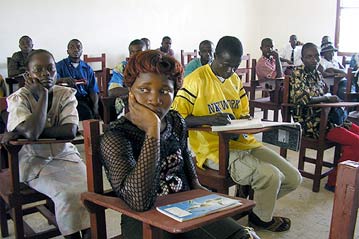
Title: The Crisis of Knowledge: Dismantling the Barriers to Education in Post-Conflict Liberia. Executive Summary: Liberia, a nation characterized by its rich history and resilience, currently faces a profound structural crisis in its education sector. With a national literacy rate hovering at approximately 47%, the country remains locked in a cycle of intellectual marginalization. This report provides an in-depth analysis of the systemic hurdles impeding educational access in Liberia, examining the interplay of historical trauma, economic instability, and infrastructure decay, while outlining strategic pathways for national reform.
The Liberian education system is not merely failing to produce graduates; it is failing to equip the next generation with the tools necessary to compete in an increasingly globalized economy, thereby stifling the nation's potential for sustainable development. Historical Context and the Legacy of Conflict: To understand the current state of education in Liberia, one must confront the profound damage wrought by the fourteen-year civil war that decimated the country between 1989 and 2003. The conflict did more than destroy physical infrastructure; it fractured the social contract, dismantled the professional teacher corps, and created a 'lost generation' of youth who were denied formal schooling during their formative years. Following the 2003 Comprehensive Peace Agreement, the nation faced the daunting task of re-establishing a public education system from the ashes.
Two decades later, the shadow of that era persists in the form of dilapidated structures, a shortage of seasoned educators, and a psychological barrier to schooling in remote regions. The war also accelerated a mass migration from rural areas to urban centers like Monrovia, placing extreme pressure on already overstretched urban school facilities while leaving rural educational infrastructure to languish. Poverty as a Systemic Barrier: Poverty remains the most formidable obstacle to education in Liberia. Despite the country's resource-rich status, the wealth gap is staggering.
A significant portion of the population lives well below the international poverty line, making the 'hidden costs' of education—uniforms, textbooks, exam fees, and stationery—prohibitive for average families. A 2019 UNICEF study highlighted that 49% of Liberian children of primary school age were not enrolled, with economic necessity forcing many to contribute to household labor rather than attend classes. This creates a generational poverty trap, where parents who were denied education cannot afford to send their own children to school, perpetuating the cycle. In many instances, the cost of schooling is not just financial but represents the loss of child labor, a sacrifice many subsistence farming households cannot afford to make.
Infrastructure and the Rural-Urban Divide: The disparity between urban and rural access is a glaring indictment of the national development strategy. Many rural schools are makeshift structures, lacking basic amenities such as electricity, running water, and sanitation facilities. In the most remote counties, children often walk hours on unpaved roads to reach a classroom that may not even have a chalkboard, let alone digital resources. Furthermore, the lack of transportation infrastructure means that even if a child is motivated to learn, the physical act of getting to school becomes a barrier.
This isolation has led to a geographic concentration of educational quality in the Greater Monrovia area, while the hinterlands remain systematically underserved. The absence of sustainable school feeding programs in these remote areas further exacerbates the issue, as hunger significantly impairs cognitive function and attendance rates. Teacher Training and Professionalism: The quality of the delivery mechanism—our teachers—is in critical condition. According to World Bank data, only 20% of primary school teachers in Liberia are formally trained, and the Ministry of Education reports that less than 40% meet the necessary professional qualifications.
This is not entirely a fault of the individuals, but rather a reflection of a system that has failed to provide incentives, competitive salaries, or continuous professional development. When teachers are underpaid and lack materials, the inevitable result is low morale, high absenteeism, and a culture of mediocrity. Without a rigorous, nationalized teacher certification process and a salary structure that rewards excellence in rural service, the system will continue to struggle with poor pedagogical outcomes. The Gender Gap: The data concerning gender parity is particularly alarming.
UNESCO figures from 2018 reveal that while 54.1% of boys were enrolled in primary school, only 36.4% of girls were in the classroom. This discrepancy is rooted in deep-seated cultural norms that prioritize boys' education over girls', alongside the pervasive threat of teenage pregnancy and sexual violence, which frequently forces young girls to drop out prematurely.
Gender inequality in education acts as a brake on the country’s socio-economic development, as the empowerment of women is statistically linked to improved health outcomes, lower infant mortality, and higher household productivity. Strategic Recommendations for Reform: Addressing these systemic failures requires more than just allocating budget percentages; it requires a radical shift in how Liberia values and delivers knowledge. First, the government must prioritize the 'de-monopolization' of infrastructure development. This involves public-private partnerships to build resilient, weather-proof school facilities in rural counties and the implementation of solar-powered off-grid technology to provide students with basic digital literacy tools.
Second, we must adopt an aggressive incentive structure for teachers. Teachers who commit to working in underserved rural regions should receive significant 'hardship' bonuses, housing allowances, and accelerated pathways for pedagogical certification. Third, education must be integrated into the social safety net. By expanding school feeding programs and providing direct cash transfers to the poorest households conditioned on school attendance, the government can directly offset the 'opportunity cost' of education for families.
Finally, the curriculum must be modernized to reflect the realities of the 21st-century workforce. We need a shift toward technical and vocational education and training (TVET) to bridge the gap between classroom theory and economic practice. The path forward for Liberia is paved with books, not just roads. Education is the bedrock upon which democracy and economic stability are built.
If Liberia is to emerge from the status of a low-literacy nation to a regional leader in human capital, it must treat the current educational deficit as a national security issue. The investment of 16% of the national budget into education is a starting point, but it must be coupled with rigorous oversight, anti-corruption mechanisms to ensure funds actually reach the classroom, and a sustained national discourse on the right to learn for every Liberian child, regardless of their parent's wealth or their village's location.
